
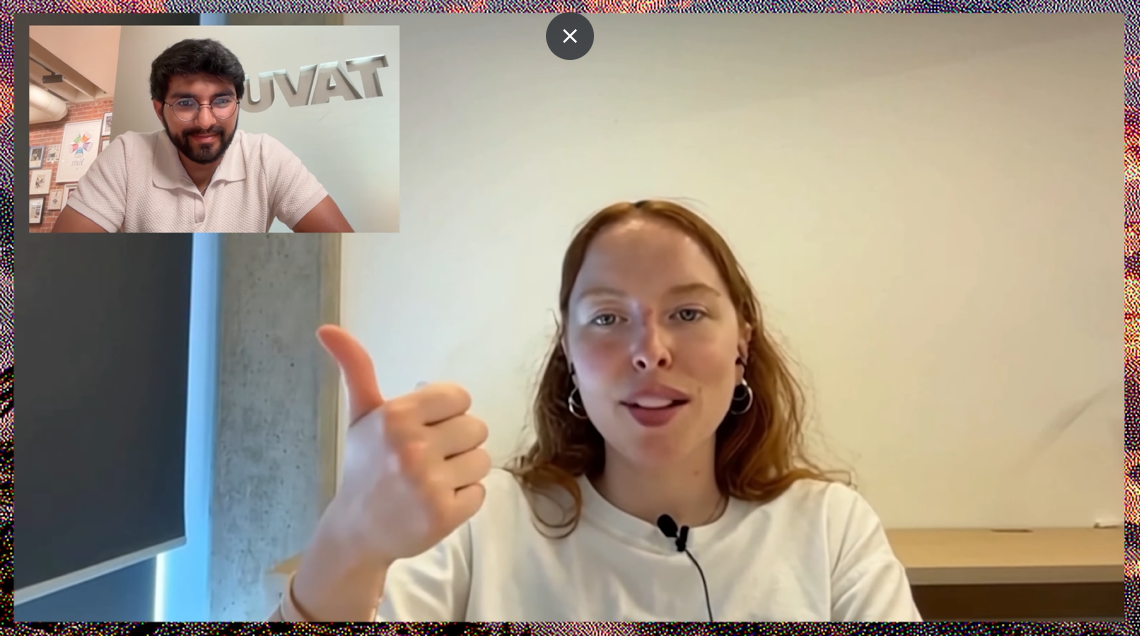
Tavus says 26 of 54 people who took part in a one-minute video call with its Griffin-Lite artificial intelligence model believed they had spoken with a real person. The result marks a sharp improvement over the company’s earlier system, although the test was conducted by Tavus itself and has not been independently verified.
A more human-like video conversation
The AI startup introduced Griffin on October 1, describing it as a “Human Interaction Model” designed for face-to-face exchanges. Unlike systems that focus mainly on text or produce video after receiving a prompt, Griffin is built to process and generate live audio and video conversation. It responds to speech while also considering facial expressions, pauses and what is happening visually.
For the test, participants were told they would be connected to another person for a one-minute conversation about what they were looking forward to during the year. They were not informed that an AI might be on the other end of the call. At the conclusion, they were asked whether they had considered that their conversation partner might not be real.
Of the 54 people who spoke with Griffin-Lite, 26—48%—said they believed their partner was human. Tavus’ previous system persuaded just one of 41 participants, or 2.4%. The company said people who became suspicious generally did so within the first 20 seconds.
The experiment should not be confused with the classic Turing test, proposed by British mathematician Alan Turing in 1950. In that test, a judge communicates with a hidden human and a hidden machine and tries to identify which is which. In Tavus’ study, participants expected to meet another person and were not told that a bot could be involved.
According to Decrypt, the results were published on Tavus’ own research page after participants were recruited through a platform the company describes as independent. A community note on X has questioned the lack of independent verification and the absence of a standard testing protocol. Griffin-Lite is not generally available to customers; access is restricted to selected trusted testers while Tavus works on safeguards.
Benchmark performance and remaining limits
Tavus also reported results from NVIDIA’s VideoFDB benchmark, which evaluates live audio and video interaction. The company said NVIDIA conducted that evaluation independently.
On the benchmark’s generation track, which assesses how natural and expressive a system’s responses are, Griffin-Lite scored 3.83 out of 5. The next-best system scored 2.80, while the human reference received 3.92. On the perception track, which tests how well a model understands what it sees and hears, Griffin-Lite scored 3.73. The strongest baseline scored 3.44, compared with 4.20 for the human reference.
The figures suggest that Griffin-Lite performed strongly in producing conversational responses but remained below the human reference in understanding audio and visual information. Tavus says Griffin is “full-duplex”: it can listen, watch and speak at the same time, more like a telephone conversation than a walkie-talkie exchange.
In one company demonstration, the model coached a man as he worked on a Rubik’s cube, using the visual information from his hands. It also waited when he stopped speaking to think. Tavus reported an average audio-to-video delay of 0.43 seconds when Griffin ran on NVIDIA H100 chips, which the company said was half the delay of the next-fastest method.
Griffin-Lite is an iteration on Tavus’ previous architecture. The earlier system combined three separate models for visuals, dialogue and perception. Tavus raised $40 million in a Series B funding round led by CRV in November 2025.
Why real-time AI identity matters
A system that can imitate a person’s face, voice and conversational timing raises concerns beyond the quality of an online demonstration. Video calls are already used in social engineering and fraud attempts, where an attacker tries to appear to be a trusted colleague, job applicant or business contact.
The source material notes that North Korea-linked hackers used deepfakes in Zoom or Teams calls in January to pose as trusted contacts. Security researchers attributed that activity to BlueNoroff, described as a subsidiary of the Lazarus Group. In the reported incidents, victims were persuaded to install malware presented as an audio fix.
Companies have also tested more direct methods of checking whether a remote participant is genuine. In 2025, Kraken’s security team reportedly flagged a suspected North Korean job applicant after asking spontaneous questions, including requests for government identification and the names of local restaurants. The candidate struggled with those prompts.
Tavus says Griffin will need additional safety measures before a public release. The company is working on disclosure features and with AI safety organizations, and currently limits Griffin-Lite to trusted testers who request access through its website. Those restrictions mean the 48% result reflects a research preview rather than a product available for general use.
Moneyiar market picture
Moneyiar market data as of October 3, 2026, around 09:23–09:24 +03:30, showed mixed performance among the listed digital assets:
- Compound (COMP): $24.669763883, up 0.6% in 24 hours and 3.48% over seven days.
- Rootstock Infrastructure Framework (RIF): $0.0818813346, up 0.13% in 24 hours but down 8.04% over seven days.
- Decimal (DEL): $0.402687183, down 6.54% in 24 hours and 12.13% over seven days.
- Huma Finance (HUMA): $0.0323360826, down 6.27% in 24 hours but up 18.47% over seven days.




