
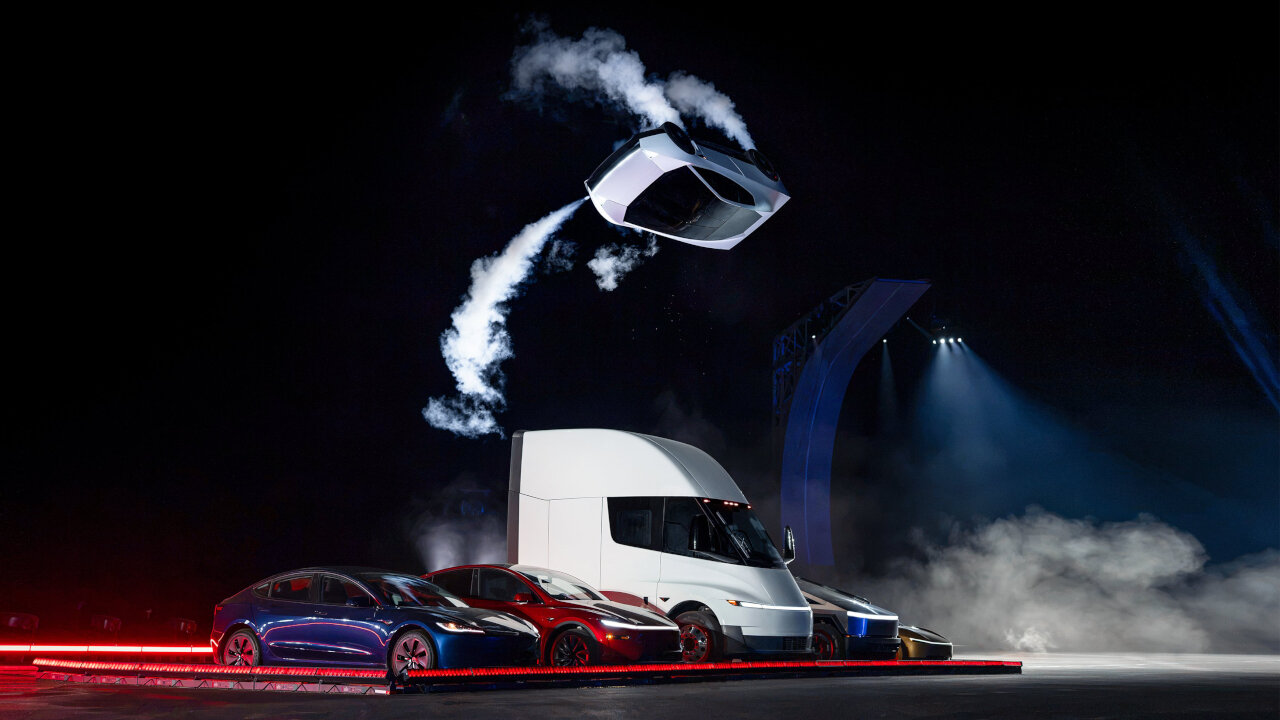
Tesla has demonstrated a new Roadster that can leave the ground, rotate in midair and return to the road on its wheels—but the most dramatic version is not approved for public road use and is available only by invitation.
The company presented the stunt on October 15 at a SpaceX test site in Texas. During the livestreamed event, the Roadster drove up an inverted ramp, launched into the air, completed a flip and landed upright. It also hopped over a line of Tesla vehicles that included a Semi truck. The demonstration attracted significant attention on social media, with the announcement on X receiving more than 10 million views.
According to Decrypt, the technology behind the jump comes from cold-gas thrusters developed with help from SpaceX. The system uses compressed air rather than burning rocket fuel. Tesla vice president of vehicle engineering Lars Moravy said the car has 10 thrusters connected to 600 liters of compressed air.
Three versions, limited access
Tesla has not published a purchase price for any Roadster configuration, but its reservation page gives an indication of the deposits requested for two versions:
- The two-seat Performance requires a $50,000 reservation.
- The Thrust requires a $250,000 reservation, with $5,000 due initially and the balance payable within 10 days.
- The single-seat Rocket, which includes the full flight system, is invite only and has no listed price.
Tesla chief executive Elon Musk said production is expected to begin in 2028. That timeline means the vehicle remains a future product even after the public demonstration, and access to the Rocket will be restricted to a selected group of customers.
Tesla lists a top speed above 230 miles per hour and driving range of more than 300 miles for the Roadster. The company says the car can accelerate from zero to 60 mph in less than one second. The on-stage demonstration recorded 0.81 seconds, while the Rocket is listed at less than 0.59 seconds.
Musk had previously promoted the next Roadster as a vehicle capable of flight, describing it as more extreme than the fictional cars associated with James Bond. Tesla now presents the model as one of the last high-performance cars designed for human drivers.
A flying car with major regulatory limits
The most important qualification is on Tesla’s own website: the flying version is not approved for public road use. When Musk was asked whether the vehicle was street legal, he replied that the answer depended on the street. No Federal Aviation Administration approval or road-safety approval for the flying version has been reported.
That creates two separate regulatory questions. A US carmaker generally self-certifies that a vehicle meets federal motor-vehicle safety standards. An aircraft, however, requires an FAA airworthiness certificate. The FAA says certification of a new aircraft type can take between five and nine years.
Existing rules also show why ownership would not automatically mean unrestricted use. Minnesota’s so-called Jetsons law permits residents to own a roadable aircraft but prohibits takeoffs and landings on public roads. New Hampshire adopted a similar law in 2020 that gave private citizens the right to own flying cars. In practice, an owner could need special authorization or licensing to operate a vehicle that functions both as a car and an aircraft.
Alef Aeronautics offers one recent point of comparison. Its Model A precursor received an FAA experimental airworthiness certificate in June 2023, allowing flight testing and marking a step toward a full type certificate. That kind of experimental approval is different from permission to operate a flying vehicle broadly in public settings.
Why the Roadster jumps instead of flying between destinations
The Roadster’s demonstration also highlights the engineering challenge of sustained flight. A 2021 paper published in Joule estimated that an electric aircraft needs about 500 to 900 watts per kilogram to hover, compared with roughly 150 to 350 watts per kilogram during cruise. Hovering therefore demands a much faster release of battery energy than ordinary flight.
Tesla’s cold-gas system avoids relying solely on the battery for that burst of lift by expelling compressed air through nozzles. That helps explain why the demonstration showed a short jump and a midair flip rather than a journey from one location to another. The event proved that the car could perform a tightly controlled aerial maneuver; it did not establish that the Rocket can operate as a conventional aircraft.
Moneyiar market picture
Moneyiar market data at the stated times showed mixed performance among the listed digital assets. Notcoin (NOT) was priced at $0.0003873384 at 21:48 on October 17, 2026, down 5.71% over 24 hours and 19.52% over seven days. Propy (PRO) stood at $0.3636259448 at 21:49, down 0.87% over 24 hours but up 3.03% over seven days.
Succinct (PROVE) was trading at $0.182007048 at 21:49, with a 24-hour decline of 3.14% and a seven-day decline of 9.78%. Spacecoin (SPACE) was priced at $0.0051401108 at 17:13 on August 29, 2026, up 6.94% over 24 hours and down 1.57% over seven days.




