
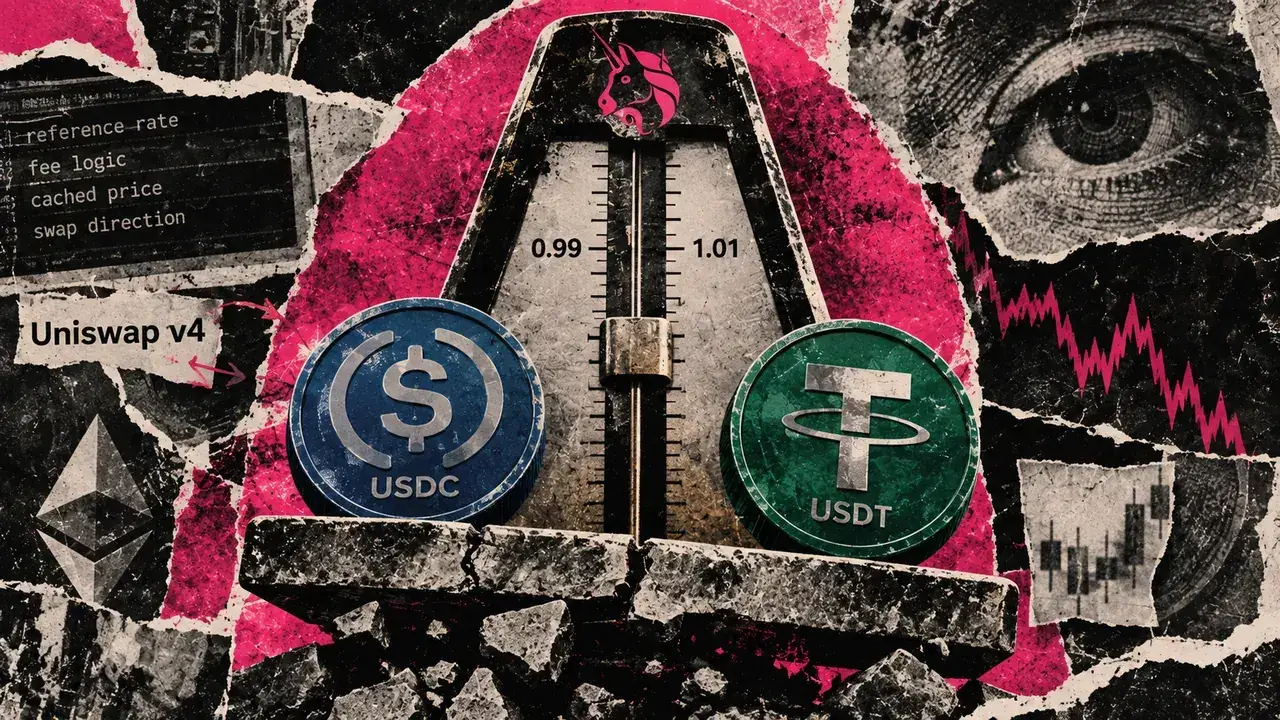
Uniswap’s StablePair hook is intended to direct more rebalancing value to liquidity providers, but its design has limits when a stablecoin no longer trades near its assumed parity. The mechanism uses a configured one-for-one reference rate and a cached pool price to determine swap fees, rather than an external market-price feed.
The result is a fee system that may reward trades correcting a temporary imbalance, while offering less protection when a token’s decline reflects a genuine change in economic value. According to CryptoSlate, the issue raises questions about how the hook’s fee income should be assessed against the inventory risk borne by liquidity providers, or LPs.
How StablePair’s fee mechanism works
StablePair is a Uniswap v4 hook, meaning a smart contract that modifies how a liquidity pool behaves. Uniswap Labs announced StablePair pools for USDC/USDT and USDC/USDG on Ethereum on Sept. 10. Its explanation of the system on Sept. 16 said that providers choosing these pools are also choosing a particular fee mechanism and the token inventory required to support it.
The deployment documentation sets a one-for-one reference rate for both pairs. The hook compares that benchmark with a cached pool price and uses the difference to determine fees according to the direction of a swap.
Within a defined band around the reference, fees vary by direction. At the benchmark, both directions pay the configured optimal fee. As the pool price approaches the edge of the band, the fee becomes lower for one direction and higher for the other. For example, with an optimal fee of one basis point, or 0.01%, a swap involving 10,000 input units at the reference would generate one unit in fees for LPs.
Outside the band, the system separates trades that push the pool farther from the benchmark from those that bring it back toward the benchmark. A trade classified as moving away can carry no LP fee, while the fee on a corrective trade declines as time passes.
This is designed to capture value from rebalancing. A trader moving the pool away may receive a favorable price relative to the configured benchmark, while another trader can arbitrage the difference by moving the price back. StablePair attempts to give the corrective trade progressively better terms rather than charging the same fee in both directions.
The first swap in each block records the pool price used for subsequent fee calculations. This block-level caching is intended to prevent traders from gaining an advantage by splitting a corrective transaction within the same block. However, it also means later trades may be assessed using an outdated price. If the live pool price crosses the reference during a block, the cached classification can temporarily identify the opposite direction as corrective until the next block.
The key risk is token value, not just pool price
The fee logic assumes that the reference rate remains a meaningful measure of value. That assumption becomes more important if the outside market stops treating the two assets as equal.
For instance, if an issuer-related shock caused one stablecoin to lose external value while the hook continued to use a one-for-one benchmark, selling the weaker coin for the stronger one could move the pool farther from the reference. At the same time, that trade could move the pool closer to the price justified by the wider market. In that situation, a trade classified as moving away from the reference may represent price discovery rather than a short-lived imbalance.
StablePair cannot assess an issuer’s solvency or restore a token’s redemption value. The source material describes this as a hypothetical scenario, not as a report of a current depeg, exploit or loss in either pool.
The inventory effect can be significant. If an LP holds 10,000 hypothetical coins and their value falls from $1 to $0.90, the position loses $1,000 in value before fees. Rebalancing income does not automatically make up that decline.
Trades also change the assets held by an LP position. If traders sell the weaker coin into the pool, they remove more of the stronger coin and leave active liquidity positions with greater exposure to the weaker asset. A trade classified as moving away from the reference and charged no LP fee provides no fee income to offset that increased exposure. The actual result still depends on liquidity, the LP’s selected range and price impact; the zero-fee classification is based on the cached price and does not mean every sale of a weakening token is automatically free.
Pool data, governance and limits
Moneyiar market data at 09:44 on Oct. 1, 2026, shows Uniswap’s UNI token at $9.0738573565, up 2.6% over 24 hours and 1.97% over seven days. The same data puts STABLE at $0.0279268477, down 2.19% over 24 hours but up 7.82% over seven days. RAIN was $0.0122474894, down 1.24% in 24 hours and up 1.85% over seven days, while RED was $0.1824875499, up 9.35% in 24 hours and 20.97% over seven days.
Uniswap’s interface showed approximately $6.1 million in total value locked and $117.9 million in 24-hour volume for USDC/USDT StablePair around 15:59 UTC on Sept. 30. USDC/USDG showed about $2.6 million in TVL and $8.7 million in volume around 15:57 UTC. A USDC/USDT v3 pool with a 0.01% fee displayed roughly $34.2 million in TVL, $15 million in 24-hour volume and $1,100 in 24-hour fees around 16:02 UTC.
Those readings were not synchronized, and the pools have different fee rules and liquidity conditions. The StablePair panels did not provide a comparable absolute fee total or realized return for individual LP positions. Volume alone therefore cannot establish whether StablePair generated better returns than another pool or than simply holding the assets.
Governance controls fee settings, implementation upgrades and role administration under Uniswap’s documented model. It can change the reference rate, which changes how swaps are classified and charged. Integrators are directed to read the hook’s live configuration because those parameters can change.
The hook also has limits. Its permanent address permissions exclude remove-liquidity callbacks and custom accounting deltas. Uniswap’s security documentation says upgrades cannot use those capabilities to block withdrawals or change swap amounts to extract additional fees. That protection does not ensure that the assets withdrawn will retain their market value.
Uniswap said OpenZeppelin reviewed the core fee mechanism of a non-upgradeable predecessor from Feb. 9 to 13, 2026, and that the block-caching approach resolved the swap-splitting issue. The later upgradeability and role model were outside that review. For LPs, the central question remains whether the assets support the benchmark and whether fee income compensates for the inventory ultimately held.




