
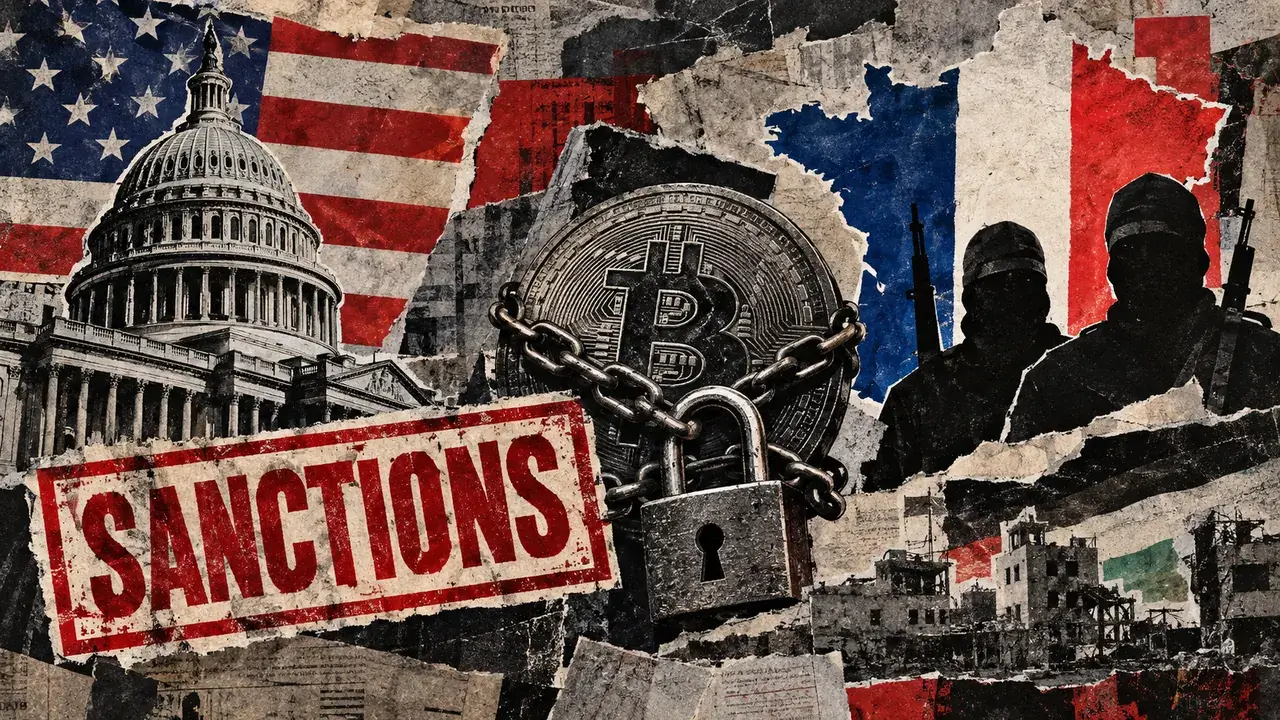
The United States has expanded sanctions linked to alleged Hamas fundraising after authorities traced cryptocurrency transfers involving France-based charities and individuals.
On October 2, the Treasury Department’s Office of Foreign Assets Control, or OFAC, added two France-based organizations and three people to its sanctions list. The designated parties are Association Baraka, Ensemble C Mieux, Faouzi Barika, Amel Oualid and Saleem Abdallah Saleem al-Zaq.
According to CryptoSlate, Treasury alleges that Barika and Oualid, both based in France, sent hundreds of thousands of dollars in cryptocurrency to al-Zaq. The agency identified al-Zaq as a Gaza-based deputy battalion commander in Hamas’ military wing.
Treasury also said the two fundraisers and organizations connected with them collected more than $2 million for Hamas between 2020 and 2026. That figure covers the broader fundraising activity described by the agency; it does not mean that the full amount was transferred through digital assets. Treasury separately attributed the cryptocurrency transfers to Barika and Oualid.
What the designations mean
The action adds the five names to the group of counterparties that crypto exchanges, custodians and payment companies subject to US sanctions rules must screen. OFAC treats digital assets under the same sanctions framework as fiat currency and other forms of property.
For companies under US jurisdiction, property in which a designated person has an interest must be blocked when it comes into the firm’s possession or control, unless a specific OFAC license or exemption applies. The restriction covers more than the individuals and organizations named directly. Companies owned 50% or more, directly or indirectly, by one or more blocked people are also subject to the blocking rule.
If a US-regulated crypto firm identifies digital assets belonging to a blocked person, it must prevent access to those assets and report the blocked property to OFAC within 10 business days. Blocked assets are also subject to annual reporting requirements.
Custodians are not required to sell frozen cryptocurrency or convert it into dollars. They may retain the assets in their existing digital form while preventing the sanctioned parties from accessing or transferring them.
Potential reach beyond US companies
The sanctions form part of broader US efforts to disrupt alleged Hamas financing networks by following digital-asset movements alongside conventional financial channels and cash-based transfers. The rules can affect companies outside the United States as well, although their application is not an automatic freeze on every blockchain transaction associated with the designated parties.
Treasury warned that foreign financial institutions could face secondary sanctions if they knowingly facilitate significant transactions for parties designated under the relevant authority. That creates potential compliance exposure for offshore exchanges and other intermediaries that service the network.
The practical effect depends on several factors, including the jurisdiction involved, ownership of the property, whether blocked assets are part of the transaction, and the significance of the activity and the parties’ knowledge. As a result, the designation does not by itself make every transaction connected to the listed names unlawful worldwide.
The next compliance challenge for crypto firms may involve identifying additional wallet addresses, intermediaries or companies associated with the alleged fundraising operation. If US authorities publish or otherwise identify more links, exchanges could need to expand screening beyond the five names announced on October 2 and review earlier activity involving the network.
Moneyiar market picture
Moneyiar market data at the stated times showed mixed performance among the listed digital assets. OriginTrail (TRAC) was priced at $0.4400754605, down 1.98% over 24 hours but up 26.39% over seven days, as of 09:49 on October 5, 2026.
FUNToken (FUN) stood at $0.0079947991, down 0.37% in 24 hours and up 6.84% over seven days at 09:49. RedStone (RED) was $0.1720966834, down 2.43% over 24 hours and up 7.57% over seven days at 09:48.
PolySwarm (NCT) was listed at $0.0167332051, with a 24-hour increase of 155.44% and a seven-day increase of 292.62%, based on Moneyiar data timestamped 07:34 on August 27, 2026. These market figures are separate from the sanctions announcement and do not indicate a direct market reaction to it.





