
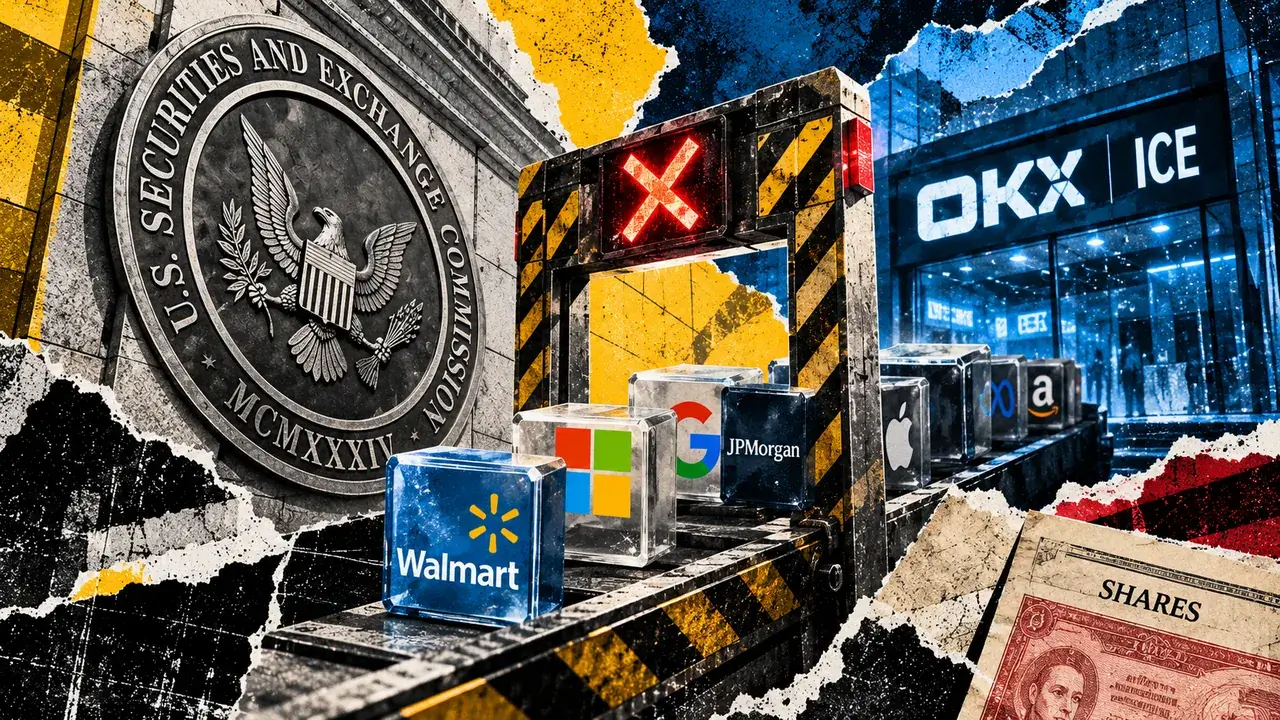
Walmart, Microsoft, Alphabet and JPMorgan Chase are among 38 companies that have objected to third-party tokens representing their shares being traded on OKXICE, a proposed 24-hour securities venue backed by an affiliate of Intercontinental Exchange, the owner of the New York Stock Exchange.
According to CryptoSlate, the objections were listed in an Oct. 28 notice from OKXICE. The companies’ responses highlight a central question for tokenized equities: whether issuers see enough value in broader, blockchain-based access to their shares when the proposed market may generate trading revenue for the venue without raising new capital for the companies themselves.
How the objection process works
OKXICE is owned equally by an Intercontinental Exchange subsidiary and OKC USA. Although ICE operates the NYSE, OKXICE is a separate proposed venue. It plans to support secondary trading through automated liquidity pools on the XLayer blockchain rather than using a conventional stock-exchange order book.
The SEC framework covering the proposal requires tokenized securities to provide shareholder rights equivalent to those attached to conventional shares. However, the framework also establishes a process allowing issuers to object when an unaffiliated third party seeks to trade tokens representing their stock.
Before such trading begins, the venue must notify the company. The issuer then has 30 calendar days after receiving the notice to submit a written objection. An objection delivered by the deadline prevents the token from trading on that particular venue.
The Oct. 28 notice names 38 objectors, including Walmart, Microsoft, Alphabet and JPMorgan Chase. Earlier reports on Oct. 24 had identified 16 companies, making the expanded list a clearer indication of the participation challenge facing OKXICE.
The SEC order does not provide a comparable routine issuer veto after that objection period has passed. That structure gives companies a strong reason to decide early, while they assess the potential effects of tokenized trading on pricing, ownership records and their relationship with investors.
Token trading creates a different incentive for issuers
The SEC’s Sept. 17 exemption prohibits primary issuance and initial offerings on covered tokenized securities venues. In practical terms, the proposed activity is secondary trading: investors trade existing exposure to shares, but the underlying company does not receive fresh share capital from those transactions.
OKXICE’s disclosed fee structure also separates the financial interests of the parties involved. Its service fee goes to the venue. Separate pool fees go to investors that provide assets for trading, while network fees go to the blockchain. The materials do not quantify a direct payment to the companies whose shares are represented by tokens.
An issuer could still view wider access to its shares as a possible benefit. But that is different from receiving proceeds from a stock sale or a clearly defined share of trading fees. The distinction helps explain why some companies may be cautious about allowing unaffiliated parties to create and trade tokenized versions of their equity.
The Securities Industry and Financial Markets Association proposed changes on Oct. 19 that could include affirmative issuer consent, a longer objection period and a universal issuer opt-out. Those proposals underline the debate over whether companies should have to act within a limited window or should instead be able to approve or reject tokenized trading more directly.
Around-the-clock access may not match the regular stock price
Tokenized shares can trade when traditional stock markets are closed, but that does not guarantee they will change hands at the same price as the underlying equity. OKXICE’s proposed liquidity pools determine transaction prices from the assets held in those pools, rather than through the standard order-book model used by conventional exchanges.
The venue warns that token prices may diverge from the underlying share price, particularly outside regular market hours or when pool liquidity is limited. A separate price for a token linked to a company’s stock could make it harder for investors to understand the value of the exposure they are buying or selling.
The SEC has identified shareholder-register maintenance and possible price dislocation, including adverse effects on the prices of underlying stocks, as risks issuers may consider. OKXICE provides for trading stoppages, including stoppages connected with halts in the underlying shares. However, beyond its disclosed stoppages, the venue does not apply additional reference-price bands, so 24-hour availability does not ensure trading close to the conventional stock quote.
Sponsored arrangements offer a different model
A separate announcement illustrates how issuer involvement can change the structure of tokenized share trading. Canton Strategic Holdings said on Oct. 29 that it had agreed with tokenized securities venue TSV LLC to make its shares available through an issuer-sponsored arrangement and had engaged Fairmint to tokenize them.
Under that plan, Fairmint TA would issue the tokens and maintain the official on-chain ownership record, with trading expected as early as Nov. 2. Both sponsored and third-party tokens covered by the SEC framework must provide equivalent shareholder rights. The difference is that Canton selected the intermediaries and the arrangement for maintaining the ownership record.
The 38 objections leave OKXICE facing an issuer-participation problem alongside its technological plans. The proposed venue may offer wider access and continuous trading, but the companies involved must weigh those potential benefits against pricing differences, recordkeeping considerations and the absence of a direct capital raise from secondary trading.
Moneyiar market picture
Moneyiar market data at the stated times show mixed performance among the listed digital assets:
- Cronos (CRO): $0.054290275, down 1.83% over 24 hours and 3.03% over seven days, as of Oct. 25, 2026, at 22:39 +03:30.
- Nexus (NEX): $0.0000006151, up 1.61% over 24 hours but down 13.97% over seven days, as of Oct. 25, 2026, at 22:38 +03:30.
- Walrus (WAL): $0.0343190471, down 0.30% over 24 hours and 11.97% over seven days, as of Oct. 25, 2026, at 22:38 +03:30.
- Propy (PRO): $0.3318772943, up 1.70% over 24 hours and down 3.95% over seven days, as of Oct. 25, 2026, at 17:19 +03:30.
These figures describe the supplied digital-asset market data and are separate from the proposed tokenized-share arrangements discussed above.




