
XRP has not delivered the same long-term gains as bitcoin, ether and several other major cryptocurrencies, remaining well below its early-2018 record despite a brief return above that level in 2025. Analysts cited by CoinDesk point to a combination of expanding supply, weaker demand, subdued fund inflows, falling activity on the market and network, Ripple’s payments-led strategy and years of regulatory uncertainty.
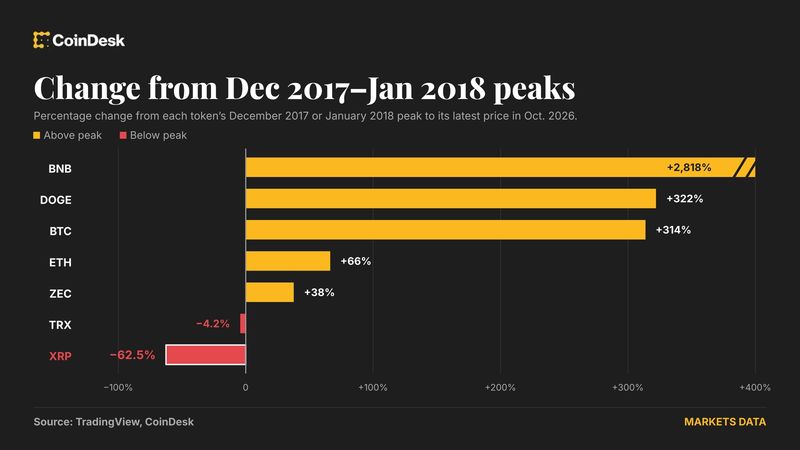
XRP was trading around $1.33 in the report, roughly 62.5% below its January 2018 peak of $3.55. That means someone who bought the token at that high was still holding a loss almost nine years later. XRP briefly exceeded its previous record in July 2025, reaching $3.66, but subsequently fell back.
The contrast with other large digital assets has been significant. Bitcoin was reported as 314% above its December 2017 peak, while Dogecoin had gained 322% from its January 2018 high. BNB was approximately 2,800% higher, Ether was up 66% and Zcash had gained 38%. Tron was slightly below its former peak. Although bitcoin, ether and other cryptocurrencies had also declined substantially from their 2025 highs, they remained well above their 2017-era records.
A larger supply changes the calculation
One of the main explanations for XRP’s weaker price performance is that the number of tokens in circulation has increased substantially. Nicolai Sondergaard, a senior research analyst at Nansen, told CoinDesk that circulating supply rose 63%, from 38.7 billion XRP in 2017 to 63.1 billion, while XRP’s total market value increased only marginally, with the report describing a decline of about 3%.
Circulating supply refers to the tokens available in the market. When supply rises without a comparable increase in total market value, each individual token represents a smaller portion of that value. That can leave the price below a previous peak even if the overall value assigned to the project has recovered.
Oliver Carding, head of marketing at institutional digital-asset manager Tesseract Group, said XRP looks more resilient when assessed by market value rather than price. With about 63% more tokens circulating than at the earlier peak, he estimated that matching the previous circulating market capitalization would result in a price roughly 39% lower.
Demand has not matched the supply growth
The other side of the equation is demand. The arrival of US-listed exchange-traded funds has created a route for institutional investors to gain exposure to digital assets, but XRP products have attracted far less money than bitcoin and ether funds.
Paul Howard, senior director at market-making firm Wincent, said ETF uptake for XRP had been muted compared with the two largest cryptocurrencies. According to SoSoValue data cited in the report, XRP funds had collected $1.80 billion since launching nearly a year earlier. Bitcoin ETFs, by comparison, can sometimes draw more than $1 billion in a single day.
Nansen data also pointed to reduced activity around XRP. Spot trading volume was down 53.5%, perpetual-futures volume had fallen 44% and the number of active addresses had declined 10.7%. These measures do not determine price by themselves, but they indicate less trading and network participation than before.
Ripple’s strategy and the regulatory overhang
Ripple, the payments company closely associated with XRP, has concentrated on cross-border payments and on developing payment infrastructure, RLUSD and trade-finance products connected with the ledger and token. Analysts said this focus has left XRP with less exposure to sectors that have attracted substantial interest elsewhere, including decentralized finance, artificial intelligence and memecoins.
Investors also have more ways to participate in crypto themes. Ether, Solana and HYPE have benefited from narratives linked to decentralized-finance investment, while XRP has not been positioned around those areas to the same extent.
Regulatory uncertainty added another obstacle. The US Securities and Exchange Commission sued Ripple and two executives in December 2020, alleging that the company had raised about $1.3 billion through unregistered XRP sales. A federal judge ruled in 2023 that XRP sales on public exchanges were not securities offerings, while sales to institutional investors were. Ripple was ordered to pay a $125 million penalty in 2024, and both sides dropped their appeals in August 2025.
Carding said the case helps explain why XRP failed to revisit its previous record during the 2021 crypto bull market, when Coinbase suspended trading. XRP later rose above $3 before falling again. Since the appeals were dropped, the report said XRP had declined about 59%, compared with falls of 32% for bitcoin and 44% for ether, while XRP’s circulating market capitalization had dropped about 56%.
Moneyiar market picture
Moneyiar data at 17 October 2026, 21:34 (+03:30), showed bitcoin at $80,923.35, down 0.89% over 24 hours and 2.50% over seven days. Ether stood at $2,383.20, down 1.40% in 24 hours and 4.93% over seven days.
XRP was trading at $1.2820, with a 24-hour decline of 1.89% and a seven-day decline of 8.90%. Ethereum Name Service was at $5.4666, down 3.77% over 24 hours and 14.29% over seven days.
XRP is also not the only large token still below its early-2018 high. Carding said six of the other nine assets that made up the top 10 during that period were further below their old levels on a price basis. For XRP, he identified its performance relative to bitcoin, monthly token distribution after re-escrow and changes in fund holdings as indicators to monitor. In practical terms, continued underperformance while new-token distribution slows would point to demand remaining weak.




