
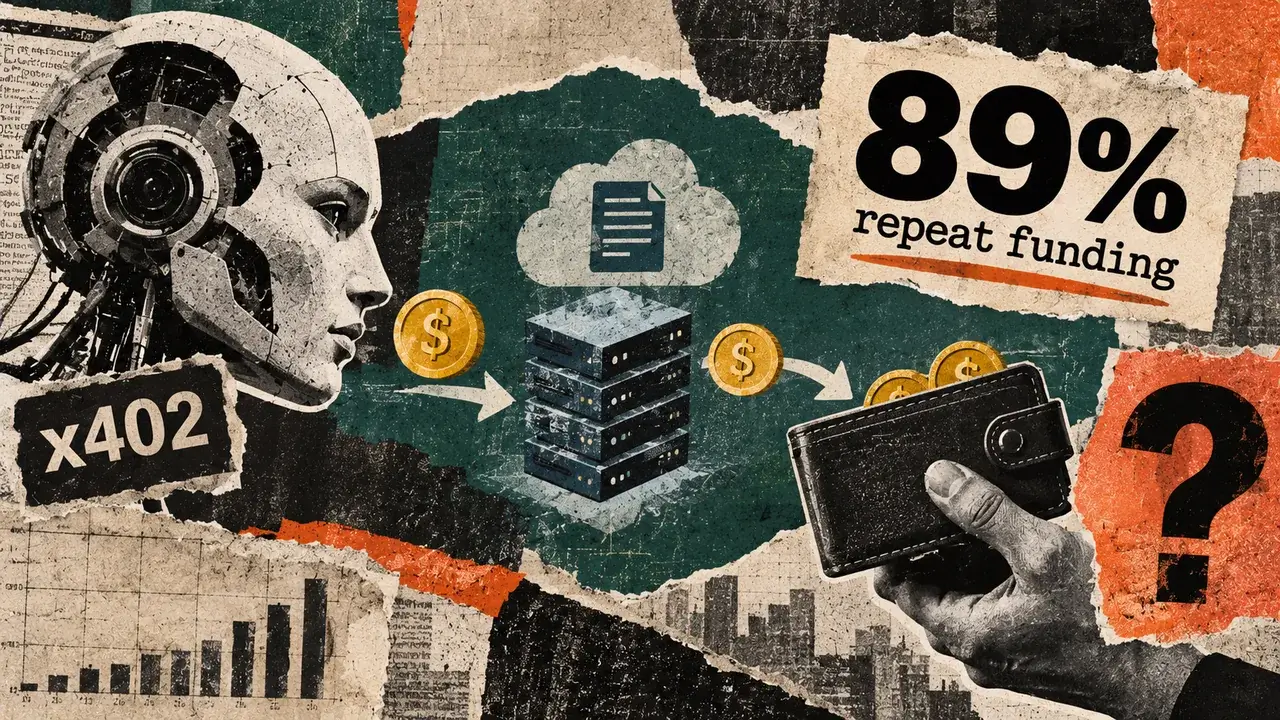
AI-driven cryptocurrency payments are showing signs of becoming recurring activity rather than one-off experiments. Nearly nine in 10 qualifying wallets using Coinbase’s x402 payment standard received fresh funding within 30 days, while the time between a wallet’s first funding and first payment fell sharply, according to reporting by CryptoSlate based on a Chainalysis analysis.
Wallet activity points to repeat use
Chainalysis found that 89.3% of x402 wallets first funded in the second quarter of 2026 received another deposit within 30 days, provided those wallets had made transactions on at least two separate days. The comparable figure for wallets first funded in the third quarter of 2025 was 70.6%.
The data suggests developers are increasingly setting up continuing budgets for software that can spend money automatically. Earlier activity around x402 was more closely associated with experiments, speculative token launches and applications that did not necessarily generate sustained demand.
The timing of payments changed even more dramatically. The median period between a wallet’s initial funding and its first payment declined to 18 minutes from 73 days in late 2025. In the third quarter, two-thirds of newly funded qualifying wallets made a payment within an hour. A year earlier, only 4% did so.
That pattern is consistent with developers funding wallets specifically for near-term automated purchases, rather than placing money into them without an immediate use.
How x402 supports machine-to-machine payments
Coinbase introduced x402 in 2025. The standard allows software applications to pay for online resources through web requests, reducing the need for a person to approve each individual purchase.
An AI agent can request information or computing capacity, receive instructions for payment, settle the charge in cryptocurrency and then access the requested service. Stablecoins are particularly relevant because they are designed to maintain a value linked to a reference asset, commonly the US dollar, and can be used for small digital payments.
The model is aimed at transactions where traditional card or banking fees may be disproportionate to the value of the service. More than 87% of x402 payments recorded during the 16 months through September were between $0.0001 and $0.10. The most common payment range was one to 10 cents.
Those charges can be used for individual requests involving AI model inference, code review, financial intelligence and data retrieval. Instead of paying a fixed subscription or negotiating an enterprise contract, a developer can purchase computing or information resources as they are needed.
By July, x402 had processed more than 138 million transactions on Base, the blockchain associated with Coinbase’s standard. AI agents and other software applications are therefore becoming participants in digital commerce, although the volume does not by itself show how much independent economic activity is taking place.
US activity leads, while China shows a different pattern
Wallets attributed to the United States represented approximately 30% of geographically identified transactions between AI agents and service providers. Their share was substantially higher in several categories: US-linked wallets generated 88.1% of AI model-inference payments, 41.8% of payments to agent frameworks and development tools, and 23.2% of transactions involving data and search services.
The concentration reflects the presence of AI developers, stablecoin issuers and cryptocurrency infrastructure companies in the US. It also places companies such as Coinbase and Circle in a position to benefit if automated commerce creates sustained demand for dollar-denominated stablecoin payments.
China’s activity was concentrated elsewhere. Chinese-linked wallets accounted for about 90% of geographically attributed payments for security and code-analysis services, much of it involving AgentLISA, a service that uses AI to audit blockchain smart contracts. Chinese wallets accounted for only 0.1% of identified AI model-inference transactions.
Chainalysis linked that difference to the greater use of open-weight models, including DeepSeek and Qwen, which can run without an external payment being made for every request. The split could affect which service providers capture revenue as automated applications become more active online.
Transaction growth faces a commercial test
The scale of x402 activity remains difficult to assess as a measure of genuine commerce. A July academic study examined 136.7 million settlements on Base worth $44.1 million and found that 21.2% were fictitious, including self-payments and closed loops. Another 63.78% took place within clusters of wallets connected through funding relationships. Such activity can include related operators as well as legitimate transactions.
The researchers identified about $187,861 in payments reaching recognizable services without detected links between buyers and sellers. Their wider estimate put potentially genuine economic activity as high as $20.26 million.
The figures underline the challenge for businesses building around automated payments. High transaction counts matter commercially only if they represent customers independently purchasing services often enough to cover computing, infrastructure and operating costs.
The same study found that 25,163 listed resources on Base corresponded to 811 distinct payment recipients, but only 249 earned at least $10 during the period examined. Recurring receipts from independent users will provide a clearer measure of whether pay-per-request services can move beyond an initial surge.
Moneyiar market picture
Moneyiar data at the stated times showed mixed performance among the listed crypto assets on October 15, 2026:
- Filecoin (FIL): $1.1830203765, up 8.16% over 24 hours and 10.05% over seven days, as of 21:38 +03:30.
- Nexus (NEX): $0.0000007385, down 4.47% over 24 hours and 7.33% over seven days, as of 21:39 +03:30.
- Walrus (WAL): $0.0515613394, down 20.43% over 24 hours but up 54.97% over seven days, as of 21:38 +03:30.
- ECOMI (OMI): $0.0002645106, down 2.50% over 24 hours and 2.37% over seven days, as of 21:38 +03:30.
These market movements are separate from the x402 usage figures and do not establish a direct connection between the listed tokens and the payment standard.




