
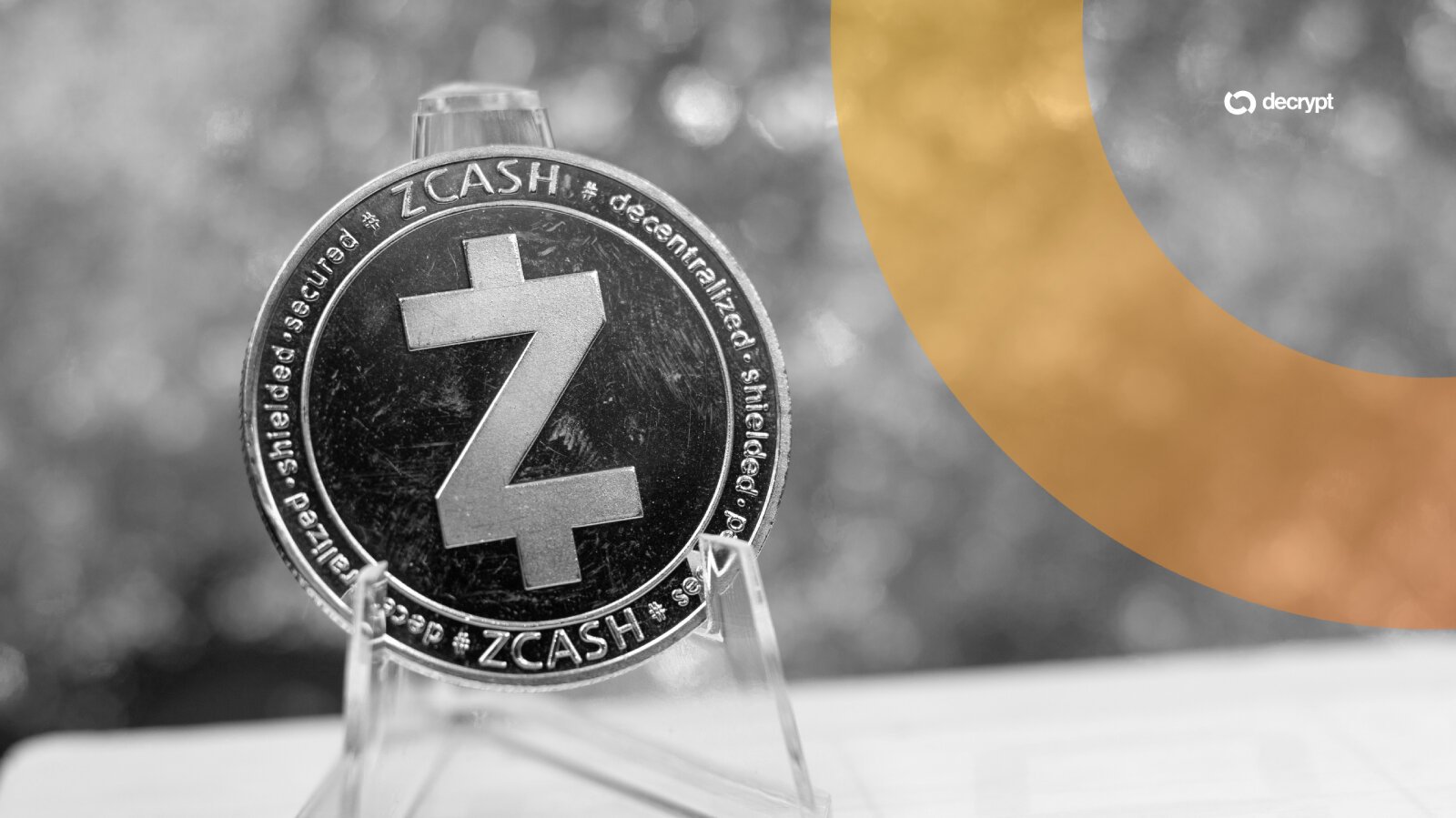
Zakura, a developer of Zcash full-node software, has proposed a wallet-level change designed to prevent a future quantum computer from linking a user’s shielded payments across addresses. The proposal focuses on ZEC swaps routed through NEAR Intents, where shielded Zcash addresses are published on NEAR’s public blockchain.
According to Decrypt, the approach would use a separate incoming viewing key for each Zcash address that must be disclosed for a swap. Zakura says the change would not require an upgrade to the Zcash network and could be added to compatible software wallets in the coming weeks.
Why shielded addresses could become vulnerable
Zcash shielded transactions are designed to conceal the sender, recipient and amount involved in a payment. Behind a shielded account is an incoming viewing key that a wallet uses to identify and decrypt payments received through the account’s addresses.
Under current cryptography, a conventional computer cannot derive that key from a published address. The concern outlined by Zakura is that a sufficiently capable quantum computer using Shor’s algorithm could eventually break the protection. If that happened, an attacker could potentially see the value and memo attached to payments received by the account and connect those payments to one another.
The issue is particularly relevant to cross-chain swaps. NEAR Intents uses a user’s shielded Zcash address as a refund address for a ZEC swap, and that address is written to NEAR’s public chain even when no refund is ultimately required. Although different swaps can display different addresses, those addresses are associated with the same Zcash account under the existing design.
That means compromising one published address could expose the relationship between multiple addresses belonging to the same account. Zakura developer Adam Tucker described this as a weakness that remains until Tachyon, a proposed Zcash scalability upgrade that its developers say would also provide full post-quantum privacy, is delivered.
Zcash Open Development Lab chief executive Josh Swihart said in May that between $600 million and $700 million had moved through Zcash’s NEAR Intents route by that point. The figure illustrates why addresses used for these swaps are an important target in the post’s analysis.
How the proposed fix would work
Zakura’s proposal leaves the account’s spending key unchanged but creates a distinct incoming viewing key for every address that needs to be published. If a quantum attacker were later able to break one of those exposed addresses, the attacker would learn only about payments sent to that address rather than being able to connect the account’s other transactions.
The design also addresses the practical burden of managing additional keys. Restoring a wallet from its seed phrase could otherwise require the wallet to search for many separate keys and slow the process. Zakura says the wallet would instead use private information retrieval to check NEAR payouts. This technique allows a wallet to query a server without revealing which addresses it is seeking.
The proposal is intended as an application-layer change rather than a consensus or network change. Zakura introduced it as “post-quantum unlinkable swaps for Zcash,” saying no network upgrade would be required.
Wallets built with Zakura’s open-source libraries, including Vizor, are expected to be able to integrate the one-time viewing keys for software wallets in the coming weeks. Hardware-wallet support is expected later, once compatible firmware is available.
Zcash’s broader quantum-security plans
The proposal follows Zakura’s plan for quantum-safe transparent addresses announced earlier in October. That plan also uses private information retrieval, while post-quantum signature opcodes were expected to reach Zcash in January, according to the source material.
Zcash has been developing a broader response to the possibility that future computing systems could compromise cryptography used by crypto wallets. Swihart said in May that the project was targeting full post-quantum status within 12 to 18 months. Separately, Ethereum Foundation researcher Justin Drake and Ethereum co-founder Vitalik Buterin have warned that artificial intelligence could threaten existing cryptographic protections before quantum computers do.
The one-time-key proposal therefore addresses a specific exposure connected with NEAR Intents while the wider Zcash roadmap is still being developed. It is designed to reduce the amount of information that could be linked if a publicly posted swap address were compromised in the future.
Market picture
Moneyiar market data at 22:29 on October 19, 2026, showed Zcash (ZEC) at $1,158.0925356628, up 4.7% over 24 hours and down 4.01% over seven days. Chainlink (LINK) stood at $12.0296922681, up 0.99% in 24 hours and down 6.3% over seven days.
Quant (QNT) was priced at $196.020123939, gaining 3.78% over 24 hours while falling 13.66% over seven days. Compound (COMP) stood at $21.6419557734, up 2.74% over 24 hours and down 8.42% over seven days.




