
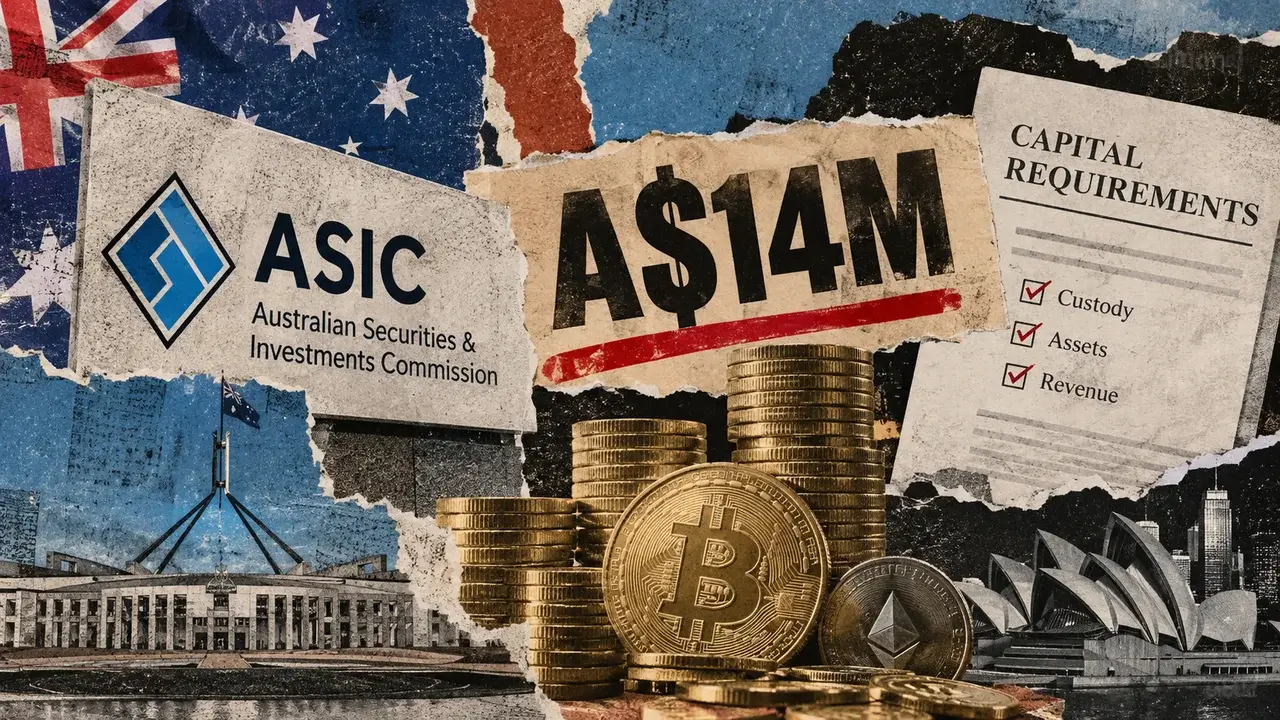
Australia’s financial regulator has proposed a stricter framework for cryptocurrency exchanges and digital-asset custodians, including new capital requirements that could begin at A$14 million for some operators. The measures are being developed ahead of a mandatory licensing regime scheduled to take effect in 2027 and would place greater responsibility on platforms that hold customer assets or facilitate digital-asset trading.
ASIC prepares rules for 2027 licensing regime
The Australian Securities and Investments Commission, or ASIC, published a consultation package on Oct. 15 covering customer-asset protection, custody, trading conduct, conflicts of interest and the financial resources exchanges must maintain. The proposals implement the Corporations Amendment (Digital Assets Framework) Act 2026, which was enacted in April and is due to take effect next year.
Under the new framework, affected businesses would need to obtain an Australian financial services licence or receive additional authorization under an existing licence. The rules would apply to crypto exchanges and tokenized custody platforms, bringing their operating safeguards closer to those used by traditional financial institutions.
ASIC Commissioner Alan Kirkland said the proposals reflect the expanding role of digital assets and tokenization in mainstream finance. He said the regulator wanted Australia to remain aligned with comparable international jurisdictions while supporting investment and innovation without reducing consumer protections.
The regulator said it has received more than 140 applications for digital-asset-related financial services under its existing framework. More than 110 of those applications were submitted during a transitional regulatory relief period that ended in September, highlighting the number of businesses seeking authorization as the new regime approaches, according to CryptoSlate.
Three capital models under consideration
The most significant uncertainty for exchanges concerns the amount of capital they would need to maintain. ASIC’s Consultation Paper 392 presents three possible approaches, with the final model yet to be selected.
Under the first model, an operator that does not qualify for a third-party custody concession would need net tangible assets of at least A$14 million or 10% of average revenue, whichever is higher. That threshold could represent a considerable cost for smaller platforms.
A lower entry point of A$200,000 would be available to platforms using qualifying independent custodians. However, the actual requirement would be the highest of A$200,000, 0.5% of average underlying asset value—subject to a A$7 million cap—or 10% of average revenue.
To qualify, platforms would have to place all underlying assets with eligible external custodians and obtain written assurances about those custodians’ financial condition, generally supported by independent audit reports. Even where an outside company holds the assets, the exchange would remain responsible for monitoring the arrangement.
ASIC’s second model would set a A$7 million capital floor for platforms holding only assets that are not classified as financial products. Platforms holding financial products would continue to face the higher threshold.
The third model would establish a A$2 million starting floor, with additional requirements based on asset holdings, revenue and activities such as brokerage, operating a trading venue and dealing directly with customers. The different options could lead to sharply different compliance costs, particularly for smaller operators.
Custody and trading safeguards would tighten
The proposed rules go beyond capital. Exchanges would need to keep detailed records, segregate customer assets, disclose significant custody risks and reconcile holdings more rigorously. ASIC is also proposing quarterly reporting on crypto-wallet arrangements and wallet addresses.
Platforms would need customers’ explicit authorization before using underlying assets in permitted arrangements. The proposals also seek to preserve customer protections if an operator becomes insolvent, while continuing to allow exchanges to use overseas custodians rather than requiring all assets to remain in Australia.
Trading controls would also become more demanding. Certain intermediaries would face best-execution obligations, including access to at least two adequate sources of liquidity. Exchanges would generally be restricted from trading as principal on their own platforms, although specified exemptions would apply.
The regulator also proposes prohibiting financial-services licensees from accepting incentives to favor particular tokens. Operators would have to assess tokens before listing them, potentially requiring reviews of assets already available on their platforms and of existing trading relationships.
ASIC has separately proposed that certain stablecoins issued, controlled or held by a licensee or its related entities could not be counted toward regulatory capital. The regulator’s position is that such holdings may not provide dependable protection if the issuing business runs into financial difficulty.
Consultation timeline and current market picture
ASIC is requesting feedback on the competitive impact and compliance costs of the proposed standards. Industry submissions are due by Nov. 27, while final guidance and regulatory instruments are expected in March 2027. Until ASIC chooses among the three capital models, exchanges will not know their final financial requirements.
The possible thresholds may encourage some smaller platforms to outsource custody, while larger operators could be better placed to retain in-house arrangements and absorb higher capital and compliance costs. The final rules will determine how those differences affect the structure of Australia’s licensed crypto market.
Moneyiar market data at 21:39 on Oct. 15, 2026, showed Ethereum Name Service at $5.7716866521, up 0.02% over 24 hours and down 7.19% over seven days. Cap was priced at $0.0788836393, rising 3.96% in 24 hours and 7.43% over seven days. Nexus stood at $0.0000007385, down 4.47% daily and 7.33% weekly, while DeepBook Protocol was $0.0231396017, down 5.38% over 24 hours but up 15.08% over seven days.




