Base has scheduled a mainnet upgrade that will give issuers of B20 tokens a separate mechanism for reassigning balances from eligible holders, adding another layer of administrative control over token movements. The Cobalt upgrade is scheduled for Sept. 30 at 18:00 UTC, with maintenance listed through 20:00 UTC, according to CryptoSlate.
What Cobalt changes
B20 is Base’s native ERC-20-compatible token standard, available in Asset and Stablecoin variants. The standard already allows administrators to establish roles and policies that govern how balances move between accounts. Cobalt extends that framework by separating administrative seizure powers from ordinary transfer restrictions.
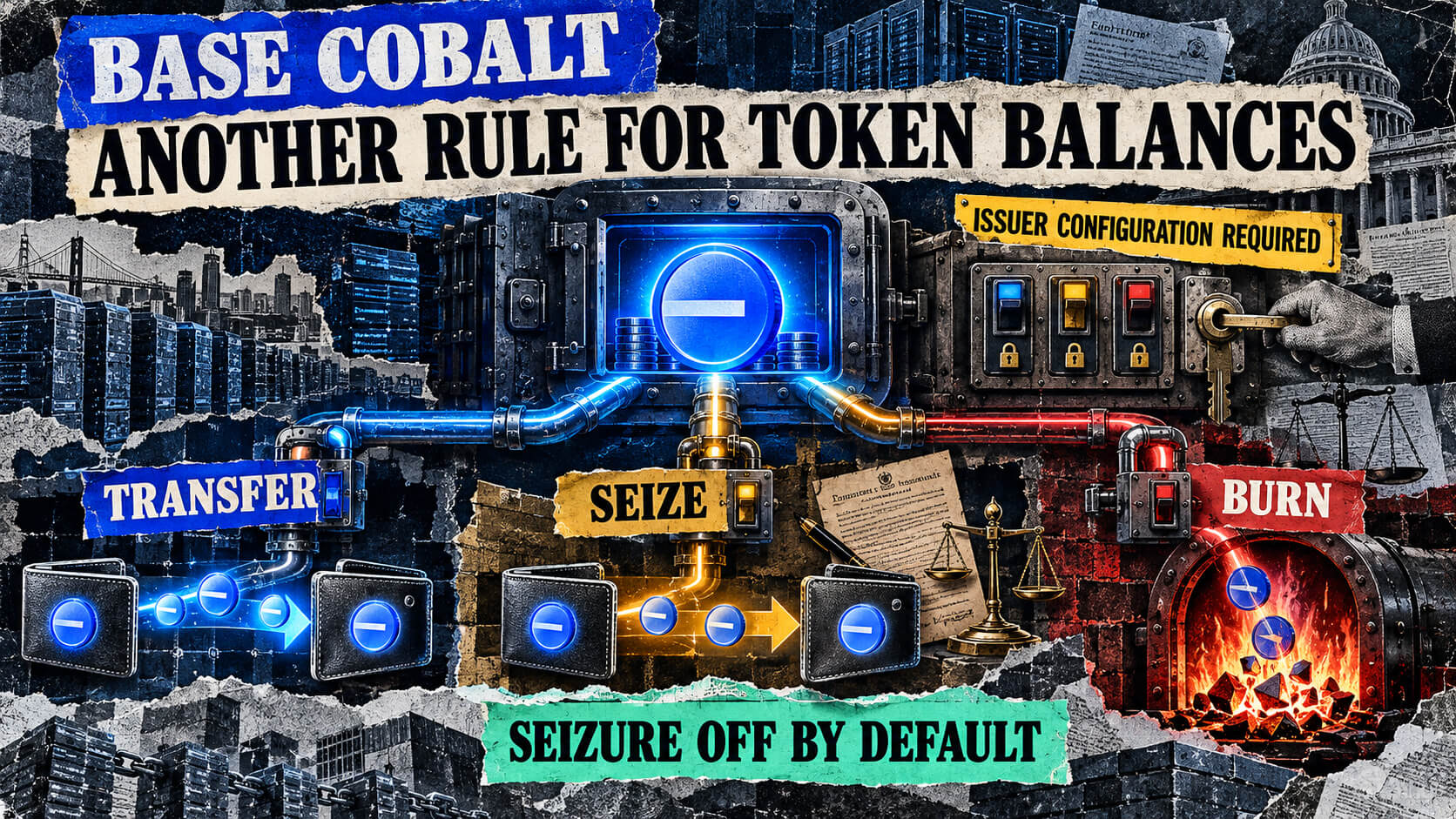
Under the new system, an issuer can enable the `seizeWithMemo` operation for a token. The function moves a specified quantity of tokens from one holder to another address. Unlike a burn, the reassignment does not reduce the token’s total supply: the tokens remain in circulation at the receiving address.
The change means a holder’s ability to make a normal transfer will not, by itself, determine whether an administrator can reassign that holder’s balance. Ordinary transfer permissions and seizure eligibility are separate questions under the upgrade.
Cobalt does not automatically activate seizure powers for every B20 token. The feature remains disabled unless an issuer configures the relevant eligibility settings. If the `SEIZE_EXEMPT_POLICY` setting is left unchanged, all accounts are exempt from seizure.
Even after an issuer configures which accounts may be affected, a seizure still requires several conditions. The caller must have the `SEIZE_ROLE`, the seizure function must not be paused, the recipient must be allowed under the applicable recipient policy, and the account must hold enough tokens for the requested operation.
Distinct permissions and token outcomes
B20’s design separates role assignments from policy settings. A role identifies which address or actor is authorized to perform a particular administrative action, while a policy determines which accounts an operation can affect. Updating a token’s rules and executing a balance operation therefore involve different permission checks.
The recipient side of a seizure is also governed separately. If no recipient policy is configured, any destination that otherwise satisfies the operation’s requirements may receive the reassigned tokens. This means the policy governing the affected holder does not automatically determine where the balance can be sent.
The upgrade also preserves B20’s existing `burnBlocked` function. That function allows an authorized caller to destroy tokens held by an account that has been denied under the transfer sender policy. Cobalt labels `burnBlocked` as deprecated, but it remains callable with its existing behavior.
As a result, issuers have two different administrative mechanisms with different consequences. Seizure transfers tokens to another address while preserving total supply. Burning removes tokens from supply. Seizure and burning also use separate administrative roles and pause controls.
The distinction matters for understanding what a balance-control rule does. A holder may be subject to a reassignment without the tokens being destroyed, while a blocked-account burn permanently eliminates the affected tokens from circulation. In either case, the relevant roles, policies and operational safeguards determine whether the action can proceed.
Mainnet timetable and market picture
Base’s status page lists Cobalt as scheduled for mainnet, with maintenance planned from 18:00 to 20:00 UTC on Sept. 30. The upgrade overview records the Sepolia test network as live since Sept. 23 and lists the mainnet release for Sept. 30. The v1.4.2 release adds Cobalt mainnet support and instructs node operators to upgrade by 18:00 UTC on that date.
The change gives B20 issuers a more specifically defined set of controls over token balances. It also makes the difference between restricting transfers, reassigning tokens and destroying tokens more explicit within the standard. The source material does not state how many B20 tokens will use the new feature or identify any particular issuer adopting it.
Moneyiar market data at 09:39 on Oct. 1, 2026, showed Polygon (prev. MATIC), now listed as POL, at $0.1119481827, down 3.89% over 24 hours but up 11.34% over seven days. Sei was priced at $0.0732921036, down 1.71% in 24 hours and up 27.68% over seven days. ORDI stood at $4.6352692635, down 0.74% over 24 hours and up 5.25% over seven days. Moneyiar’s data lists Polygon under the symbol MATIC without a price in the supplied snapshot.