
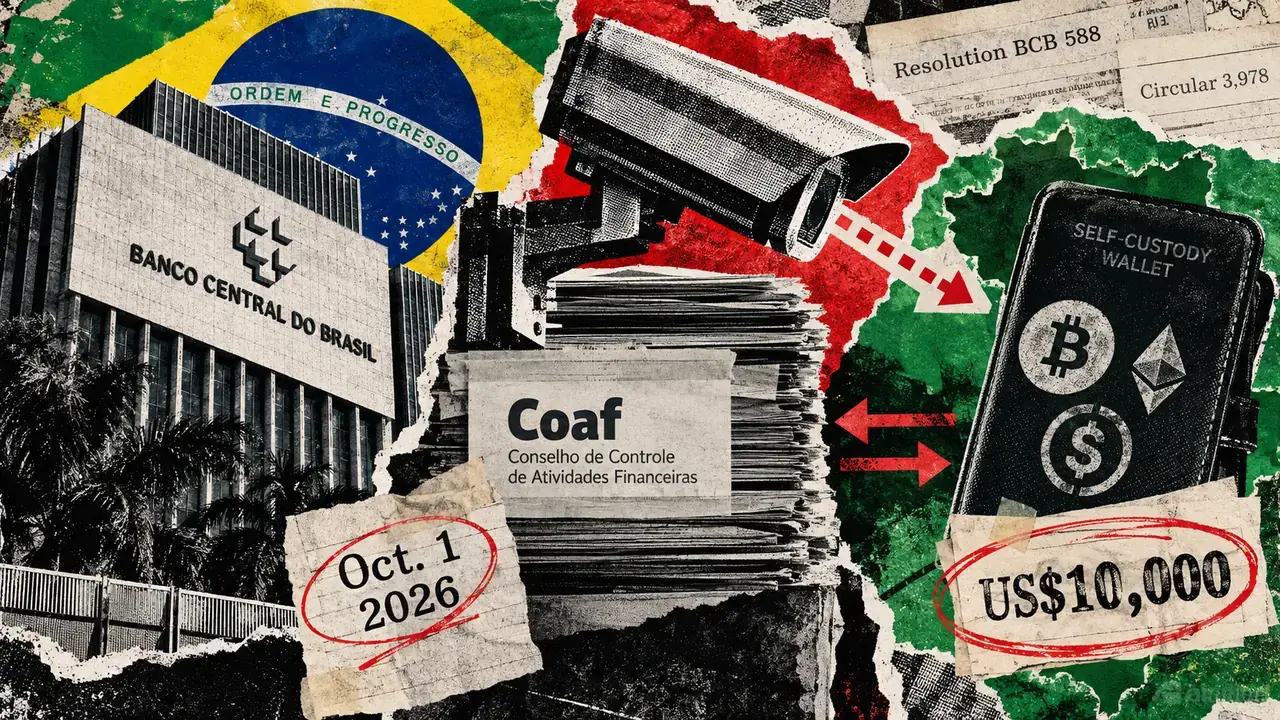
Brazil is introducing a new reporting requirement for large cryptocurrency transfers involving self-custody wallets, bringing transactions between regulated platforms and users’ personal wallets under closer anti-money-laundering scrutiny.
From Oct. 1, financial institutions and other firms authorized by the Banco Central do Brasil will have to notify Brazil’s Financial Activities Control Council, known as Coaf, when they send or receive virtual assets worth at least $10,000 through a self-custody wallet. The requirement is established under Resolution BCB 588.
The filing must be made by the institution processing the transfer and submitted by the next business day under Brazil’s existing anti-money-laundering framework. It applies in both directions: transfers from a regulated institution to a wallet controlled directly by a user, and transfers from such a wallet into a regulated platform.
Automatic reporting, not a suspicion test
The $10,000 threshold operates automatically. A bank, exchange or other covered provider will not need to conclude that a transaction is suspicious before reporting it. A legitimate customer withdrawal to a personal wallet, or a deposit from that wallet, can therefore enter Coaf’s reporting system simply because it meets the value and transaction-type requirements.
Brazil already requires financial institutions to report transactions they consider suspicious. The new rule creates a separate reporting layer for qualifying self-custody transfers, giving authorities greater visibility into large movements between regulated financial businesses and wallets managed outside those platforms.
Self-custody means that users hold or control the private keys needed to access their crypto assets, rather than leaving custody with an exchange or another service provider. That arrangement can make the identity of the person controlling a wallet less directly visible to a regulated intermediary. The new requirement targets the point where assets cross between that private-wallet environment and Brazil’s regulated crypto system.
The operational burden will fall on the institutions handling the transactions. Covered firms will need to identify whether a counterparty is a self-custody wallet, calculate the value of transfers, and connect their monitoring systems to automatic Coaf reporting before the October deadline.
Further controls scheduled for January
The October reporting rule will be followed by another measure affecting certain crypto transfers leaving regulated institutions. Resolution BCB 584 is scheduled to take effect on Jan. 1, 2027, and establishes a precautionary holding procedure for some outbound virtual-asset transactions.
Under that framework, qualifying transfers may be delayed while additional checks are carried out. The rules also allow an earlier release when specified conditions are met. As a result, regulated providers will need procedures not only for reporting certain transfers but also for reviewing and, where applicable, temporarily holding some withdrawals.
Together, the resolutions increase scrutiny when crypto enters or exits Brazil’s regulated financial system. Exchanges, banks and other covered providers face a short period to prepare for the October reporting obligation before the January framework adds another compliance process.
Rule arrives in one of Latin America’s largest crypto markets
The changes are being introduced as Brazil remains a major centre for digital-asset activity. According to CryptoSlate, Brazil recorded $252.5 billion in crypto activity during the period measured by Chainalysis. That made it Latin America’s largest crypto market and placed it first in Chainalysis’ 2026 global crypto adoption index, while the United States ranked second overall.
Brazil’s overall position reflects broad participation across different types of activity rather than leadership in every individual category. It ranked third in flows through crypto services, fourth in on-chain balances, third in domestic peer-to-peer activity and second in cross-border flows.
The scale of the market means the threshold could affect high-value individual users, trading firms and businesses that frequently move assets between exchanges and private wallets. Those users are more likely to conduct transactions large enough to trigger automatic filings, while service providers will be responsible for identifying and reporting the qualifying activity.
At the same time, Brazil’s measured crypto economy declined 1.6% during the latest period covered by the data. The new compliance rules are therefore arriving even though recent activity has cooled, adding regulatory and operational requirements during a period of contraction.
Moneyiar market picture
Moneyiar data at the stated times show the following prices and moves:
- Comedian (BAN): $0.0680565597, up 4.16% over 24 hours and 0.14% over seven days, as of Sept. 25, 2026, at 22:03 +03:30.
- Walrus (WAL): $0.0370371029, up 8.43% over 24 hours and 21.41% over seven days, as of Sept. 25, 2026, at 22:04 +03:30.
- Billions Network (BILL): $0.0139971939, down 0.59% over 24 hours and up 10.04% over seven days, as of Sept. 21, 2026, at 01:39 +03:30.
- Zilliqa (ZIL): $0.0037871662, up 1.36% over 24 hours and 21.93% over seven days, as of Sept. 25, 2026, at 22:03 +03:30.





