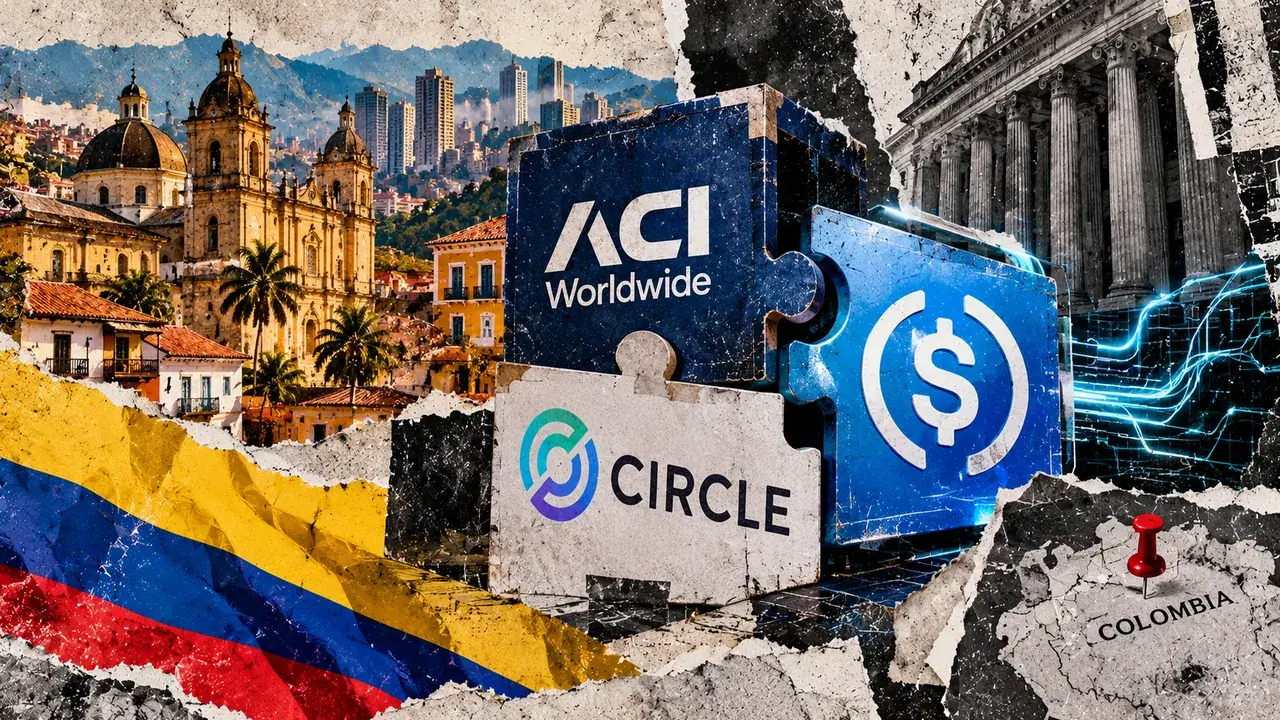
Circle is moving to connect its USDC stablecoin with established banking infrastructure in Latin America through a partnership with payments technology company ACI Worldwide. The first test will take place in Colombia, using the country’s Bre-B instant-payments network.
According to Decrypt, the initiative is designed to demonstrate how stablecoin settlement can operate alongside conventional payment systems. Rather than replacing bank rails, Circle and ACI are presenting USDC as another settlement option within a broader, multi-rail payments environment.
How the Colombia pilot will work
The project combines Circle’s USDC infrastructure with ACI Connetic, ACI’s cloud-based payments orchestration platform. ACI built the central infrastructure supporting Bre-B, Colombia’s interoperable instant-payments network.
The pilot will examine how USDC, a digital asset designed to maintain a value of one U.S. dollar, can fit into a real-time, account-to-account payments system. The companies say the approach is intended to help financial institutions evaluate stablecoin settlement using processes and infrastructure that are already familiar to them.
That focus reflects a broader change in the banking discussion around stablecoins. Financial institutions are increasingly considering practical questions such as how digital-dollar settlement could work with treasury operations, governance requirements and existing payment workflows.
“The conversation around stablecoins is moving from possibility to practicality,” Craig Ramsey, ACI’s global head of account-to-account payments, said. He described the collaboration as an effort to integrate regulated stablecoins into banking workflows.
Circle’s regional expansion
The Colombia initiative adds to Circle’s efforts to expand USDC across Latin America and other emerging markets. Circle has already established a regional foothold through Mercado Pago, which added USDC in Argentina.
The companies identified Colombia as the starting point for the pilot. The country has significant cross-border remittance activity, while dollar-denominated savings are familiar to many residents as a way of protecting purchasing power during inflationary periods, according to the source material.
Kash Razzaghi, Circle’s chief commercial officer, said financial institutions across Latin America are examining how stablecoins can support payment development within infrastructure they already use. The comments position USDC as a link between traditional financial systems and digital-asset networks.
ACI’s platform is described as technology-agnostic. Although the initial pilot uses USDC, the system is designed to support other payment networks and digital-asset providers over time. The partnership therefore has a wider scope than a single stablecoin integration, even though Circle is the first participant named in the project.
USDC market picture
Moneyiar market data at 2026-10-25 22:38 +03:30 put USDC at $0.9998375755. The stablecoin was down 0.01% over seven days, while its reported 24-hour change was 0%.
The Colombia pilot matters because it tests stablecoin settlement in the operating environment banks already depend on: instant payments, account-to-account transfers and established financial controls. Its stated aim is not to choose between traditional rails and digital assets, but to show how both can function together within one payments ecosystem.