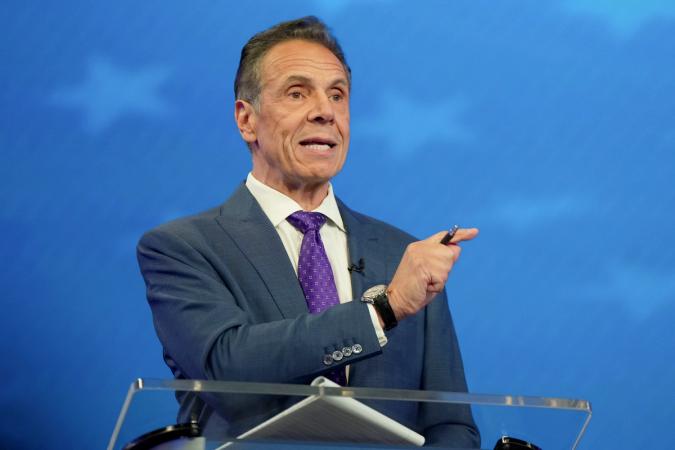
Companies declining to let tokenized versions of their shares trade on a planned OKX-ICE venue are behaving as regulators and market operators expected, according to Andrew Cuomo, the venture’s co-chairman.
Companies Take a Wait-and-See Approach
Sixteen companies have objected to having tokenized versions of their shares traded on OKXICE, a planned venue created by crypto exchange OKX and Intercontinental Exchange, the parent of the New York Stock Exchange. The latest group includes Microsoft, Alphabet, Goldman Sachs, Qualcomm, Caterpillar, McDonald’s and Western Digital.
They joined previously disclosed objectors including Broadcom, Verizon and UnitedHealth. The objections were listed in a public notice released Monday, adding to an early debate over how traditional companies should participate in blockchain-based securities markets.
Cuomo, who is also an OKX board member and a former governor of New York, said the venue was designed to allow issuers to decide whether to take part. Speaking during a press call on Tuesday, he described companies’ reluctance as a normal reaction to a market structure that represents a significant change from conventional share trading.
He said many companies would be expected to observe the market first rather than become early participants. The decision to opt out at this stage does not necessarily prevent a company from reconsidering later, as the trading system and related safeguards develop.
What the SEC Experiment Allows
The planned market is being developed under the Securities and Exchange Commission’s five-year “Innovation Exemption,” which was introduced roughly a month before the companies’ objections became public. The framework gives qualifying venues room to test trading systems that use automated market makers and liquidity pools.
In broad terms, tokenized stocks are digital representations of shares that use blockchain infrastructure. The proposed model could allow U.S. investors to trade stocks around the clock through a venue built for digital assets, rather than relying only on the operating hours and systems of traditional exchanges.
The experiment is deliberately limited. Cuomo said restrictions apply both to the number of companies that can participate and to trading volumes. He characterized the arrangement as a sandbox or demonstration model, rather than a fully scaled replacement for established stock markets.
The framework also gives issuers a formal role. Companies have a 30-day period in which they can object to their shares being included. Dave Hendricks, chief executive and founder of Vertalo, an SEC-registered digital transfer agent and tokenization software platform, said the objections show that this part of the framework is being used as intended.
Questions Over Pricing and Shareholder Rights
The objections also highlight the practical questions companies are asking before joining tokenized markets. Carlos Domingo, chief executive of tokenization firm Securitize, said it was reasonable for issuers to seek clarity about pricing, investor protections and shareholder rights.
Those issues matter because a tokenized share must connect a blockchain-based trading system with the rights and ownership records associated with a conventional security. Issuers may also need to assess how trading prices are formed, how investors are protected and how shareholder rights are preserved.
Domingo said companies have multiple ways to participate in tokenization, including approaches sponsored directly by issuers. Securitize announced earlier this month that it planned to offer 12 tokenized stocks to U.S. investors and make them available on OKXICE’s venue. Microsoft and Alphabet are among the stocks included in that offering.
However, their objections to OKXICE do not by themselves establish that they oppose Securitize’s separate offering. The two situations involve different arrangements, making it important not to treat an objection to one venue as a rejection of tokenization in every form.
Hendricks identified another obstacle: the absence of a system that can coordinate trading on traditional exchanges with trading on tokenized securities venues. He said current infrastructure does not yet normalize, harmonize and synchronize the two environments while enforcing the framework established by the SEC’s exemption.
That gap could help explain why more companies are objecting during the initial phase. Hendricks said an objection made before the necessary connections are in place could eventually become acceptance once the market’s infrastructure develops.
Moneyiar Market Picture
Moneyiar data as of October 21, 2026, at 08:29 +03:30 showed the following digital-asset prices and moves:
- Compound (COMP): $25.5939848406, up 19.13% over 24 hours and 11.09% over seven days.
- Four (FORM): $0.2504686529, up 1.93% over 24 hours and down 8.11% over seven days.
- AKEDO (AKE): $0.0343759604, up 2.08% over 24 hours and 33.53% over seven days.
- Alchemy Pay (ACH): $0.0055258427, up 3.33% over 24 hours and down 6.72% over seven days.
These figures provide a snapshot of selected crypto assets while the OKX-ICE initiative works through issuer participation, market safeguards and the technical links needed for tokenized stock trading. The corporate objections are therefore an early part of the testing process, not a final determination of whether the model will expand.