
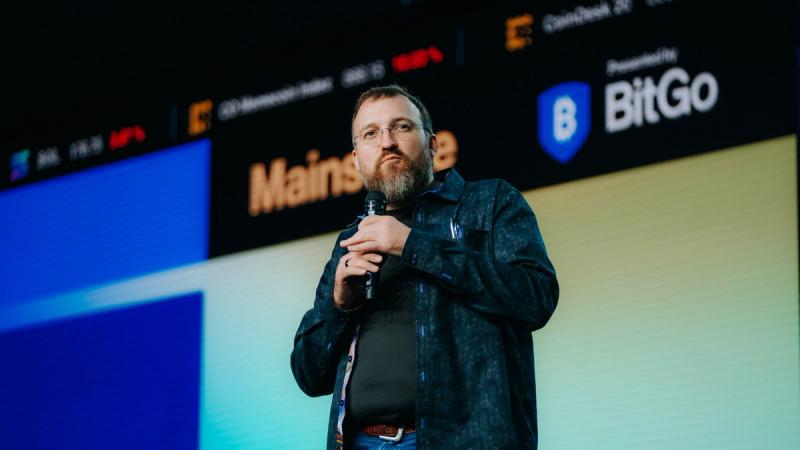
Cardano founder Charles Hoskinson is personally developing a new programming language intended to combine transaction requests with cryptographic evidence that the requested conditions were satisfied. He is working with Lucas Rosa, an Input Output Global engineer and co-creator of Aiken, one of Cardano’s existing smart contract languages, according to CoinDesk.
The project remains at an early and largely undisclosed stage. Hoskinson has not revealed the language’s name, published code or said when developers will be able to use it. No technical specifications or release timetable have been announced.
A language built around verified transactions
The proposed language would bring together three components: transaction intents, proof-carrying data and Groth16 proofs. The combination is designed to help applications express what a user wants to happen, provide evidence that the relevant rules were followed and allow that evidence to be checked efficiently.
A transaction intent describes the desired result rather than requiring the user to specify every step needed to achieve it. For example, a trader might request an exchange of one token for another only if the final price satisfies particular conditions. The application could then determine the steps required to complete the request.
Proof-carrying data adds cryptographic evidence to information. That evidence can show that the information complies with specified rules, allowing another application to verify it without repeating all of the calculations that produced it.
Groth16 is a proof system that creates compact proofs which computers can verify quickly. Such proofs can demonstrate that a condition was met without exposing the private data used to meet it.
Together, these elements could allow Cardano applications to coordinate trades, evaluate complex conditions and transfer verified information between services. Instead of processing every underlying calculation on the network, Cardano could check a comparatively small proof at the end of the process.
How the project fits Cardano’s existing tools
Cardano already supports smart-contract development through Plutus, which is built on Haskell, and Aiken. Smart contracts are programs deployed on a blockchain to carry out rules or actions when specified conditions are met.
Rosa’s involvement connects the new project with Aiken, which he co-created. Aiken is one of the principal languages already used for Cardano smart contracts, while Plutus is another established option for developers working on the network.
The initiative also differs from the programming environment associated with Midnight, the privacy-focused blockchain developed by Hoskinson’s company, Input Output Global. Midnight uses Compact for applications that process confidential data.
Hoskinson’s decision to work directly on the new language is notable because Input Output Global has a team of engineers developing the company’s blockchain technologies. However, the available information does not establish how the language will relate to, replace or complement Cardano’s existing development tools. It also does not specify whether the project is intended for a particular category of application.
At this point, the proposal describes a direction for application development rather than a publicly available product. Developers cannot yet inspect public code or use the language based on the information released so far.
What is known—and what remains unclear
Hoskinson announced the work in a post on X, saying that he is personally developing the language with Rosa. He did not provide a name, detailed specifications or a date for developer access.
Those omissions leave several practical questions unanswered, including how the language would be implemented, how it would interact with Cardano’s current smart-contract systems and what tools developers would receive. The source material also does not provide details about performance, deployment requirements or any planned applications.
The core concept is nevertheless clear: users could describe intended transaction outcomes, applications could attach evidence that the required rules were met, and compact proofs could make verification more efficient. Whether that concept becomes a usable Cardano development tool will depend on the release of further technical information and public code.
Cardano market picture
Moneyiar market data at 9:59 p.m. local time on Oct. 19, 2026, showed Cardano’s ADA at $0.2172068334, up 0.87% over 24 hours but down 8.69% over seven days. The figures describe market performance at that time and do not indicate how investors may respond to the programming-language project.
For comparison, Gram (previously Toncoin) was priced at $1.3569158646, up 2.05% in 24 hours and down 0.32% over seven days. Request traded at $0.0529775824, gaining 1.05% over 24 hours and 0.20% over seven days, while RedStone stood at $0.1368906515, up 2.34% on the day but down 11.22% across the week.





