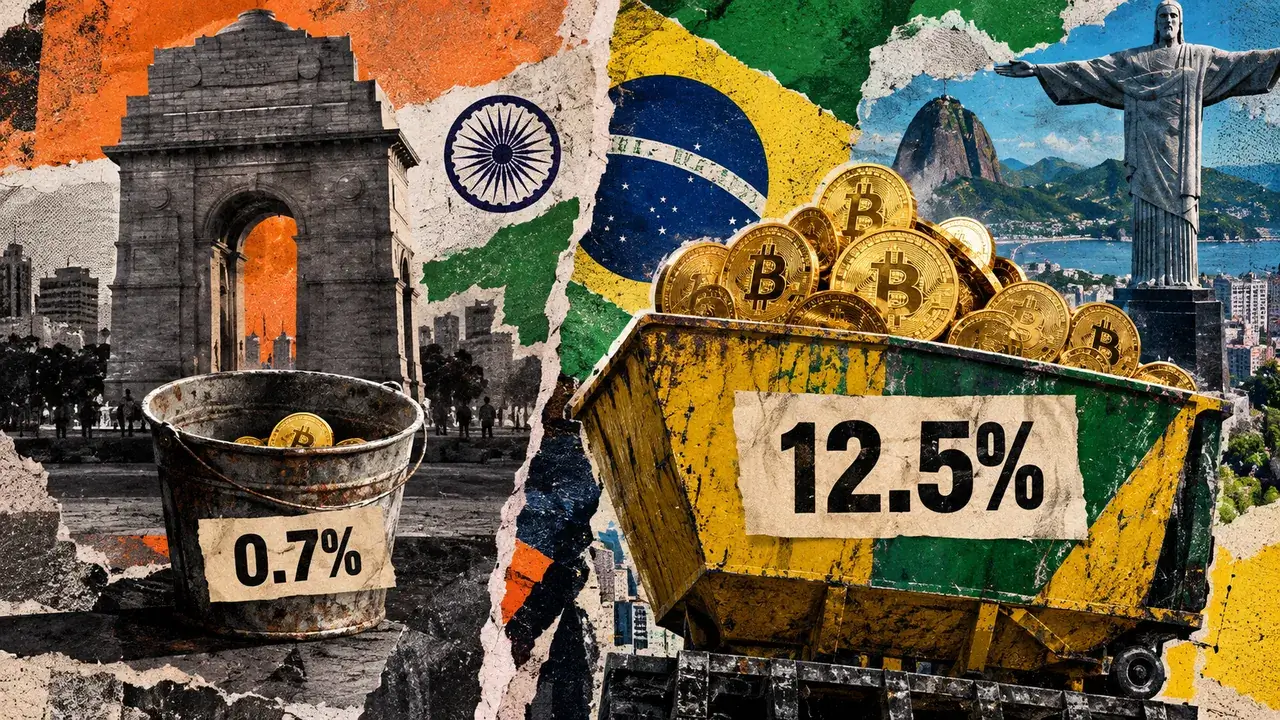
India’s cryptocurrency users accounted for $88.4 billion in centralized-exchange inflows during the year covered by Chainalysis’s latest regional analysis, but platforms based in India received only 0.7% of exchange value, according to reporting by CryptoSlate. The figures highlight the difference between where crypto users are located and how much business is captured by exchanges operating in their home market.
India’s users are active, but local platforms capture little
Chainalysis identified India as the largest market in Central and Southeast Asia and Oceania by centralized-exchange activity attributed to users in the country. The analysis covered the period from July 2025 through June 2026, although the precise dates used for the reported domestic-exchange share were not specified in the chapter’s prose.
The share of exchange value received by Indian platforms fell from about 7% to 0.7%, with the report pointing to a sharp decline in mid-2022. That measure concerns value received by exchanges. It does not directly represent executed trades, exchange revenue, customer numbers or the amount of assets held on a platform.
The distinction matters because Indian users can send funds to exchanges headquartered abroad. Chainalysis assigns activity to countries using estimated user locations, rather than simply counting the activity of companies incorporated in each country. Its broader 2026 methodology uses website traffic for geographic allocation and adjusts traffic shares for income differences using the square root of GDP per capita.
The company also acknowledges that removing VPN and bot traffic is imperfect. As a result, the figures are estimates of geographically attributed activity rather than a complete record of every user or transaction.
Brazil shows a sharply different exchange pattern
The report’s comparison with Brazil points in the opposite direction. Brazil-based exchanges received 12.5% of inflows in the latest observation, up from 1.5% previously. The exact dates for those share observations and whether the platform sample remained consistent were not specified in the published chapter text.
Brazil’s wider crypto economy recorded $252.5 billion in activity in the year ended June 30, despite contracting by 1.6%. That total covers a broader range of activity than exchange inflows, so it cannot be used directly to calculate the dollar value received by domestic exchanges without matching data on the relevant period, sample and denominator.
Chainalysis cited regulatory clarity, investment and stronger local offerings as possible factors behind Brazil’s increased domestic share. Interviews in the report also discussed corporate stablecoin use for liquidity and cross-border transfers. Those observations describe potential sources of demand, but they do not establish how much any individual factor contributed to the exchange-share difference.
The contrasting results provide two separate views of a country’s crypto market. India has substantial activity attributed to local users, while its domestic venues capture a small reported portion. Brazil, by comparison, has a larger reported share of inflows reaching locally based exchanges.
India’s withholding rule is part of the debate
India’s tax framework may affect how much cash remains available after some crypto sales. Section 393 of the current Act provides for 1% withholding on consideration for a virtual digital asset transfer paid to a resident, subject to applicable exemptions. The responsible payer deducts the amount at the earlier of credit or payment.
Because the calculation is based on the consideration paid for the transfer, the deduction can reduce immediately available proceeds even when the transaction generates little gain. For example, a liable ₹100,000 sale would result in ₹1,000 being withheld before fees or other adjustments, leaving ₹99,000 available to the seller at that point.
The withheld amount can be claimed as tax credit when the recipient files a return, and the Act allows a refund claim where tax paid exceeds the final liability. However, tax credit and trading liquidity operate on different timelines: the deduction reduces cash available for another transaction immediately, while the final tax position is determined later.
Exemptions depend on the payer and the tax-year aggregate consideration. The stated threshold is ₹50,000 for eligible individuals or Hindu undivided families meeting the relevant conditions, and ₹10,000 for other payers. The rules also refer to prior-year business turnover or professional-receipts limits in determining eligibility.
CoinSwitch co-founder Ashish Singhal told Chainalysis that tax friction helps explain the use of offshore venues, arguing that foreign platforms may not make the deduction. That is an industry explanation rather than a measured finding. The available data do not show how much withholding contributed to India’s fall in domestic-platform share, and a platform’s location alone does not establish that it is exempt from Indian obligations.
Market picture
Moneyiar market data at 09:53-09:54 on October 5, 2026, showed mixed performance among the listed crypto assets:
- JUST (JST): $0.1410533108, up 0.86% over 24 hours and 10.12% over seven days.
- Aptos (APT): $0.811913473, up 2.20% over 24 hours and down 0.17% over seven days.
- Four (FORM): $0.2835592592, down 0.37% over 24 hours and 2.43% over seven days.
- BAS (BAS): $0.0235953274, down 2.67% over 24 hours and up 2.97% over seven days.
The Chainalysis findings therefore concern the structure and destination of exchange activity, not a forecast for crypto prices. They show that strong user participation in a country does not necessarily translate into a similar share for exchanges based there.