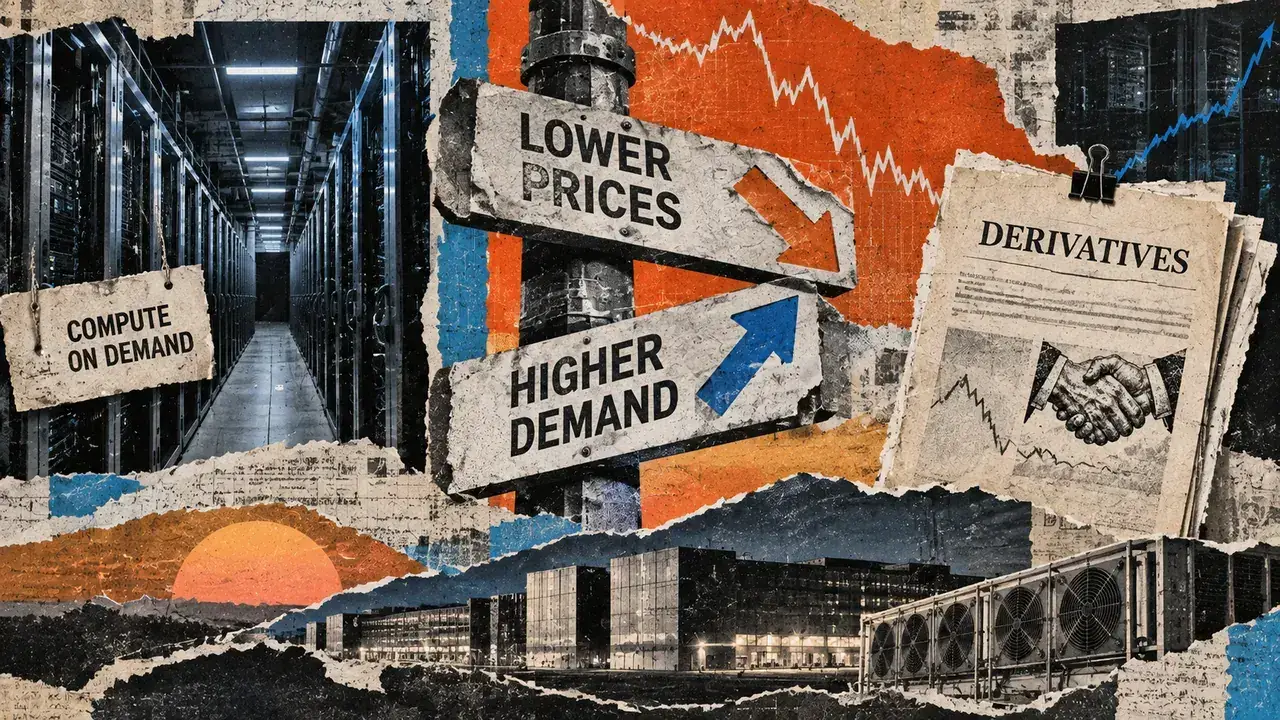
Companies that have spent heavily on GPUs to serve the artificial-intelligence market may soon have a new way to manage falling rental income. Luxor and CME Group are developing financial contracts linked to AI computing prices, potentially allowing GPU operators to offset some of the damage when customers pay less for access to their machines.
The initiative comes as AI businesses increasingly rent computing capacity rather than purchase their own equipment. That model can reduce operating costs for application developers, but it creates pressure for infrastructure owners that financed large fleets of GPUs on the assumption that rental rates would remain high enough to cover debt and other costs.
According to CryptoSlate, Luxor is already brokering agreements between owners of computing capacity and customers seeking access to it. However, its cash-settled derivatives activity remains at an early stage. The company said a liquid market had not yet formed and did not provide examples of customer hedges or current derivatives trading volumes.
How an AI compute hedge would work
A cash-settled derivative would separate the financial protection from the physical rental of computing capacity. An operator could continue renting its GPUs to customers while using a contract tied to a benchmark price to offset part of any decline in rental rates.
For example, an operator expecting to sell 1 million GPU-hours in a month at $2 per hour would anticipate $2 million in rental revenue. A GPU-hour represents access to one processor for one hour. If the relevant benchmark fell to $1.50, a contract could pay the operator the 50-cent difference across 1 million hours, or $500,000. If the operator’s actual rental revenue also fell to $1.5 million, the combined amount would return to $2 million before fees and other costs.
The protection would work in both directions. If the benchmark rose to $2.50, the operator would owe $500,000 under the contract while receiving higher rental income from customers. The trade-off is less benefit from rising prices in exchange for greater predictability when prices fall.
A long-term customer agreement at a fixed rate offers a more familiar form of revenue certainty, but customers may not know their future computing needs. Derivatives could offer operators protection without requiring them to commit their machines to a single user for an extended period. Dealers might connect parties with opposing risks or absorb some exposure themselves in return for compensation.
CME Group is pursuing an exchange-traded version through announced futures tied to H100 and B200 rental indexes. Its August 11 announcement targeted October 5 for the contracts, subject to regulatory review. The futures are linked to Silicon Data’s GPU rental benchmarks. A listing, however, does not guarantee that enough participants will trade the contracts to make them liquid or inexpensive to use.
Benchmark differences could weaken the hedge
The main challenge is ensuring that the benchmark used for settlement reflects the prices an operator actually receives. If customers negotiate a rate of $1.25 while the benchmark declines only to $1.50, the same $500,000 payment would leave the operator with $1.75 million rather than the $2 million target in the example. The difference is known as basis risk: the protected price does not move exactly in line with the real business price.
AI computing is particularly difficult to standardize. Two machines with similar technical specifications may provide different services depending on factors such as how long access is guaranteed and whether a customer’s workload can be interrupted. Long-term, uninterrupted capacity is not necessarily comparable with short-term access that can be stopped when the provider needs the machines.
Luxor has compared the opportunity with its experience in Bitcoin mining. Its hashprice measure provides a reference for what a unit of mining computing power can earn. Bitcoin miners perform the same network task, while AI customers may value similar hardware differently depending on their workloads and service requirements.
Price providers already account for distinctions such as interruptibility and commitment length. CCIR’s rental-data methodology treats those characteristics separately, although it relies on publicly advertised rates that may not reflect privately negotiated discounts. Luxor’s AI Hardware Price Index measures advertised prices for selected GPU systems, but the price of buying equipment is not necessarily the same as the rental income that equipment can generate.
Luxor has also described expanded compute spot pricing as forthcoming. Operators seeking protection would still need a contract that identifies a rental benchmark and demonstrates that it tracks their customer revenue closely enough.
Counterparty and cash-flow risks remain
A hedge is only as reliable as the party responsible for paying it. If a counterparty also depends heavily on AI infrastructure, falling computing prices could hurt both businesses at the same time. Collateral may reduce that risk by requiring money or eligible assets to be posted against obligations, but collateral also ties up funds that could otherwise be used to pay operating expenses or debt.
Cash-flow timing matters as well. When rental prices rise, an operator may owe money under its hedge before customers have paid their larger invoices. A contract can be economically useful over the full period while still creating a difficult short-term funding requirement.
Luxor did not provide AI collateral terms or explain procedures for a counterparty default. Its response also did not clarify how its customer-arranging activities are separated from its own trading, an issue relevant because its launch announcement disclosed an internal compute trading fund.
The market picture at the time of Moneyiar’s data update, October 3, 2026, was mixed: Uniswap (UNI) was at $9.2373981565, up 2.12% over 24 hours but down 3.87% over seven days; Compound (COMP) stood at $24.6310268043, up 0.47% in 24 hours and 3.77% over seven days; The Graph (GRT) was $0.0279910924, down 4.36% over 24 hours and up 0.8% over seven days; and ApeCoin (APE) was $0.162712966, up 4.01% over 24 hours and 4.95% over seven days. These figures are Moneyiar data recorded at approximately 09:33-09:34 +03:30.
AI compute derivatives cannot eliminate losses caused by weaker rental rates. They could, however, shift part of that exposure to another participant and make income easier to plan. Their effectiveness will depend on benchmark quality, sufficient trading liquidity, affordable collateral and counterparties able to meet their obligations when the market is under pressure.