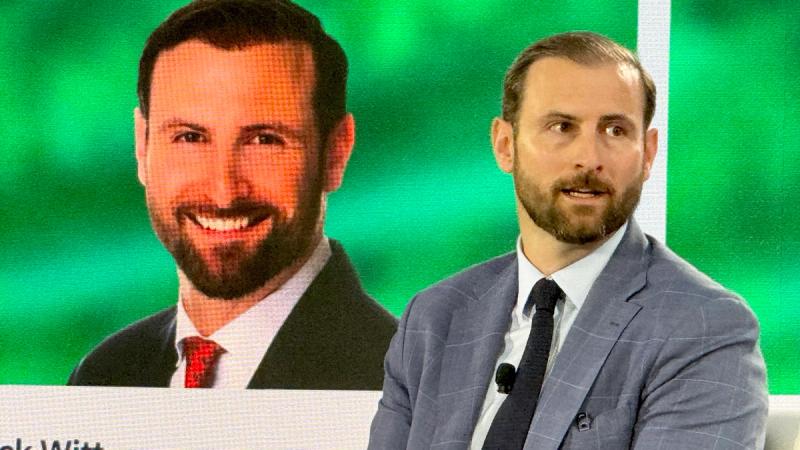
The departure of Patrick Witt has left the White House without a clearly identified official overseeing President Donald Trump’s digital-assets policy, creating uncertainty around an administration initiative that once had a prominent public presence. The White House says crypto remains a priority, but it has not announced who will take over Witt’s role or whether the position will be maintained in its previous form.
According to CoinDesk, Witt confirmed his departure on Wednesday night after reports that he had already left. He thanked regulators and lawmakers involved in negotiations over the Digital Asset Market Clarity Act and said he would move into the private sector. A White House official praised Witt’s work but did not say who would replace him.
A policy office loses its final crypto adviser
Trump’s administration initially placed digital assets near the center of its technology agenda. Before Trump returned to the White House in 2025, he named former PayPal executive David Sacks as his incoming AI and crypto czar. The administration also created the President’s Council of Advisors for Digital Assets.
The council began as a small operation, with Bo Hines serving as its first director. Hines became a prominent White House representative for the crypto industry, holding meetings with industry participants and appearing at sector events. His roughly eight-month tenure included the passage of the Guiding and Establishing National Innovation for U.S. Stablecoins, or GENIUS, Act.
Stablecoins are digital tokens designed to maintain a stable value, generally by being linked to an established asset such as a national currency. The GENIUS Act established U.S. legislation for stablecoin issuers, marking a significant congressional achievement for the administration’s crypto agenda.
After the law was enacted, the White House held a signing and celebration attended by prominent crypto figures. The administration then issued a broader digital-assets agenda describing its plans to support the sector in the United States.
Hines later joined Tether’s U.S. operation. His consulting firm, Nxum, which he founded with his father and another partner, also received millions of dollars as the principal service provider to a new political action committee. CoinDesk previously reported on the committee, which was funded mainly by Cantor Fitzgerald, Tether’s U.S. financial partner, and led by a Tether executive. The Wall Street Journal reported this week that Nxum received consulting payments from Tether while Hines was working at the White House on the GENIUS Act.
Clarity Act negotiations remain unresolved
Witt, who had served as Hines’ deputy, took over as executive director of the digital-assets council. He became the administration’s most visible advocate for the Digital Asset Market Clarity Act, legislation intended to create a U.S. regulatory framework for crypto markets.
Witt was outspoken during the negotiations, including on X, where he criticized what he viewed as obstacles to the Senate bill. Sacks left the crypto czar position in March, leaving Witt and deputy Harry Jung to help coordinate the administration’s digital-assets position.
The talks were complicated by President Trump’s own involvement in the crypto industry. Democratic lawmakers sought restrictions preventing senior government officials from maintaining personal crypto interests. As negotiations continued and elections approached, the White House offered concessions that would have imposed unusually strict ethics limits on the president’s digital-assets activities. Democrats said those measures did not go far enough.
Witt had said in July that he had upcoming military-service commitments with the Georgia National Guard. He nevertheless remained in place to finish the Clarity Act negotiations. The legislation later stalled, failing to advance in a Senate floor vote before lawmakers left for an extended break ahead of next month’s elections.
Crypto’s place in the administration is unclear
The White House has said that crypto and the Clarity Act will continue to be priorities for Trump. However, the administration’s recent decision to appoint former Securities and Exchange Commission Chairman and current intelligence director Jay Clayton to lead its Super Intelligence Force did not include a crypto responsibility, even though the role had previously combined artificial intelligence and digital assets.
Clayton’s appointment is notable because he led the SEC when the agency began its approach to crypto enforcement that critics later described as “regulation by enforcement.” The administration still has policy advisers and crypto-related regulatory efforts underway at agencies including the SEC, but no individual has been publicly designated as the White House’s new in-house crypto lead.
For crypto businesses and lawmakers, the vacancy raises questions about who will represent the administration in future discussions, particularly while the market-structure legislation remains blocked. The White House has not said whether Witt will be replaced or whether responsibility will be distributed among existing officials.
Moneyiar market picture
Moneyiar data at 20:58-20:59 on October 15, 2026, showed the following prices and moves:
- Polygon (prev. MATIC), now shown as POL, was $0.0955655698, down 0.22% over 24 hours and 3.22% over seven days.
- OFFICIAL TRUMP was $1.8745556857, up 0.38% over 24 hours and 2.92% over seven days.
- REAL, listed with the symbol ASSET, was $0.1927052765, up 3.26% over 24 hours and down 2.28% over seven days. Its quoted timestamp was October 8, 2026, at 18:54 +03:30.