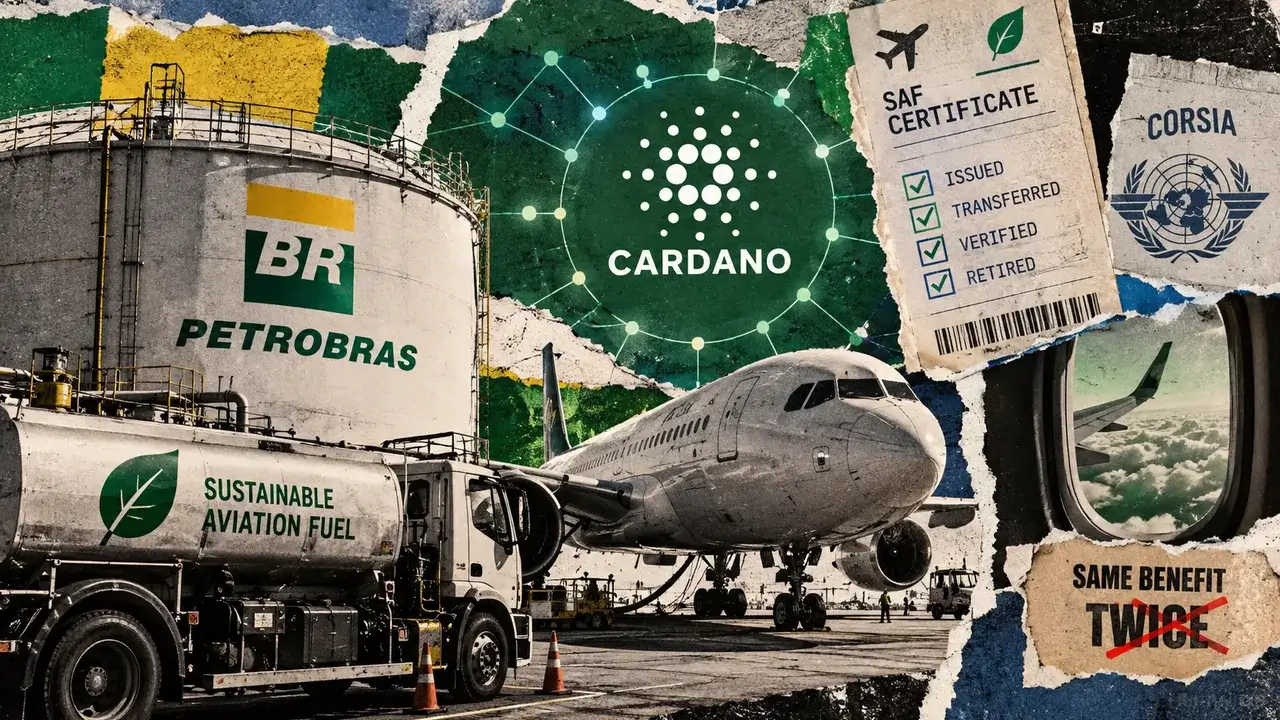
Brazil’s state-controlled energy company Petrobras is testing Cardano-based tokens to track the environmental benefits of sustainable aviation fuel (SAF), seeking to prevent the same benefit from being claimed more than once.
The work is part of an ongoing research and development collaboration involving Petrobras, the Cardano Foundation and PUC-Rio University’s Ledger Labs. According to CryptoSlate, the project has produced applications covering both SAF and Diesel R, Petrobras’ renewable fuel brand.
A digital record for SAF claims
The SAF initiative focuses on a challenge created by the separation between physical fuel and environmental benefits. Under a Book-and-Claim model, an airline, company or passenger can receive the environmental benefit associated with SAF even if the fuel was produced or used somewhere else.
That arrangement can broaden access to SAF-related benefits, but it also requires a reliable way to show who has received a claim and whether it has already been used. Petrobras’ platform represents SAF environmental attributes as standardized CS-SAF tokens on the Cardano blockchain.
The tokens can be created, transferred, checked and retired. Retirement is intended to stop the same environmental attribute from being claimed again. The platform also keeps the digital record connected to the original fuel certificate, creating a traceable link between the claim and the SAF from which it originated.
The Cardano Foundation compares the problem with double spending in digital assets: a digital item must not be reused after it has already been transferred or claimed. In this case, the item being protected is an environmental benefit rather than money or cryptocurrency.
The Foundation says travelers can enter their departure and destination airports, calculate a CS-SAF allocation and receive a certificate showing the route, distance and allocation. The resulting claim remains linked to the original SAF certificate. The tokens also contain metadata aligned with CORSIA, the Carbon Offsetting and Reduction Scheme for International Aviation.
Book-and-Claim does not change the physical fuel
The project’s digital accounting system does not mean that the buyer physically receives the SAF used to support the claim. Guidance published by the Roundtable on Sustainable Biomaterials on June 16 says Book-and-Claim changes neither the physical fuel used by a buyer nor the emissions associated with that fuel.
The guidance says airlines should report supported reductions separately from their operational emissions. It also allows different participants in a value chain to make distinct claims, provided their disclosures do not misrepresent the overall reduction.
That distinction is important for interpreting the Petrobras project. The Cardano system is designed to record the allocation and retirement of an environmental benefit; it is not presented as a system that moves fuel between locations or changes the underlying emissions of a flight.
Diesel R expands the proposed tracking model
The R&D work also covers Diesel R. Developed with PUC-Rio, the proposed model would place checkpoints across the fuel’s production, transportation and use.
Its objective is to create a continuous record across the fuel lifecycle. Such a record could support Scope 3 reporting, which concerns indirect emissions generated across a company’s wider value chain. The model would connect information held by suppliers and logistics providers, giving emissions reporting a more traceable supply-chain history.
The Cardano Foundation describes the Diesel R architecture as a proposed model within the research and development work. The disclosures do not quantify commercial usage of either initiative. No transaction volumes or revenue figures were provided, leaving the scale of any business deployment unclear.
Current Cardano market picture
Moneyiar data at 09:44 on Oct. 1, 2026, shows Cardano (ADA) at $0.2472375736. ADA was down 0.42% over the previous 24 hours but up 5.43% over seven days.
The source material also describes Cardano as ranked No. 14 by market capitalization and reports a 0.47% gain over 24 hours. The Moneyiar figures are the current market data used here; the difference in the reported 24-hour movements reflects the separate data points and timestamps provided.
The Petrobras initiative therefore remains an R&D case involving blockchain-based tracking of SAF benefits and a proposed fuel-lifecycle model for Diesel R. While the work shows how Cardano can be used to record, transfer and retire environmental attributes, the available disclosures do not establish the projects’ commercial scale.