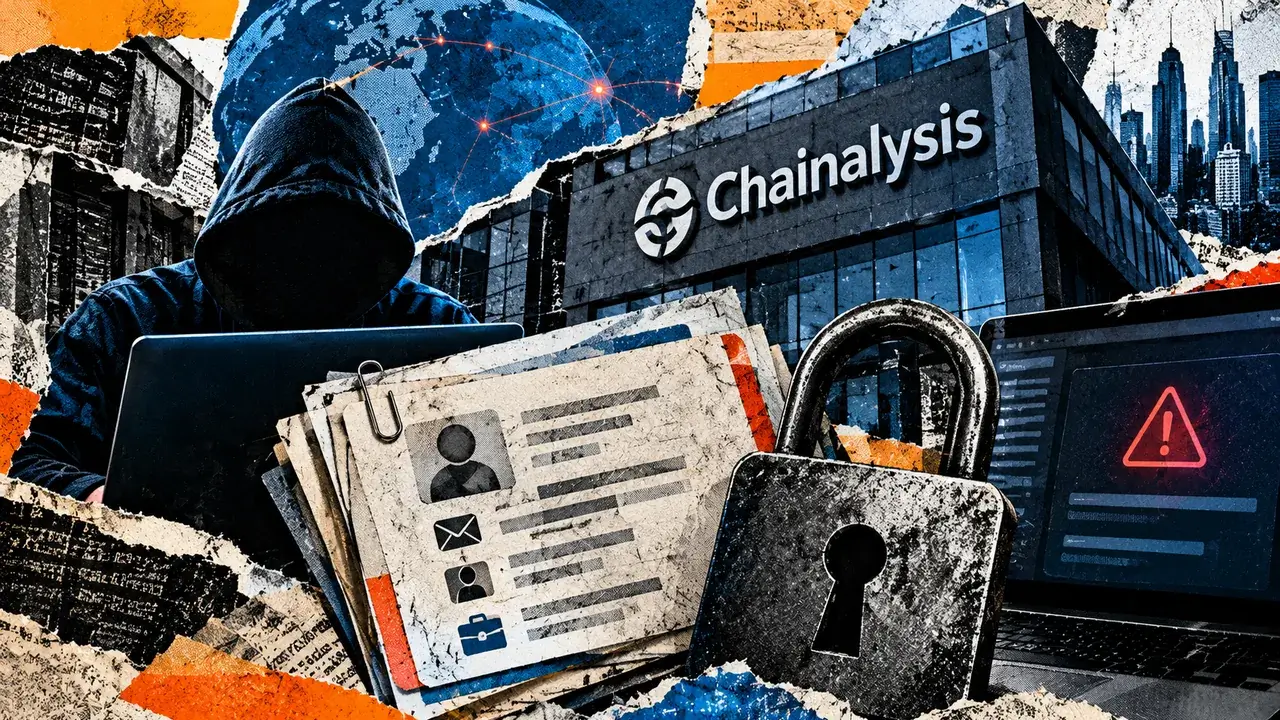
A cryptocurrency trader in the United Kingdom says masked intruders held him at knifepoint and forced him to transfer about $760,000 in digital assets, adding to concern over the spread of violent “wrench attacks” against crypto holders.
The trader, who uses the pseudonym “realist” on X, said the attackers broke into his home, destroyed his phone and compelled him to make two transfers. He said approximately $40,000 was taken from a hot wallet and about $720,000 from a Ledger wallet, putting the claimed loss close to $800,000.
The trader posted a Solana wallet address on the blockchain explorer Solscan as evidence supporting his account. However, police and other authorities have not confirmed that the robbery occurred or independently verified the details. According to CoinDesk, the account therefore remains an unconfirmed claim.
How the alleged robbery worked
A hot wallet is a cryptocurrency wallet connected to the internet, while a hardware wallet such as Ledger is designed to keep key information in a physical device and provide an additional layer of security. In this case, the trader said physical threats enabled the attackers to overcome protections that would normally be relevant to remote theft.
The term “wrench attack” describes a robbery in which criminals use violence or the threat of violence to make a crypto holder surrender assets. The expression reflects the fact that attackers can bypass digital safeguards by targeting the person who controls the wallet rather than trying to hack the wallet itself.
The alleged U.K. incident follows a reported robbery in the country last December. In that case, masked attackers were said to have beaten a cryptocurrency investor with hammers and threatened to kill his pregnant wife unless he transferred hundreds of thousands of pounds in crypto.
The latest trader’s warning on social media urged people in the U.K. who own cryptocurrency to leave the country. The statement underscores a problem specific to self-custodied digital assets: controlling private keys can protect against some online threats, but it cannot by itself prevent someone from using force to obtain access or compel a transfer.
Violent crypto theft is being tracked globally
Data cited in the report indicates that physical attacks are becoming a more prominent part of the security risks facing cryptocurrency owners, alongside hacks, phishing schemes and smart-contract exploits.
Chainalysis estimated that criminals stole more than $30 million through violent attacks during the first half of 2026. Home invasions represented 37% of recorded incidents during that period, compared with 14% a year earlier, according to the blockchain analytics firm.
France was identified as a major concentration of reported cases. Chainalysis documented at least 30 incidents there in the first six months of the year. Separately, blockchain security firm CertiK identified 52 verified attacks worldwide during the same period, including 33 in France.
The figures come from industry tracking rather than a police-confirmed assessment of the U.K. trader’s claim. They nevertheless show why crypto security discussions increasingly extend beyond passwords, encryption and private-key storage. The person, home and information surrounding a digital-asset holder can also become targets.
What the incident means for crypto holders
The reported attacks have implications for anyone whose holdings are visible or whose trading activity makes them identifiable as a potentially valuable target. Measures discussed in connection with this risk include keeping ownership information confidential, limiting public disclosure of trading activity and separating funds intended for immediate access from longer-term reserves.
Those steps may reduce exposure to some forms of targeting, but they cannot remove the possibility of physical violence. Unlike a conventional online attack, a wrench attack depends on coercion, intimidation or assault, meaning no individual technical safeguard can guarantee protection.
The alleged theft also illustrates the difference between asset security and personal safety. A hardware wallet may help protect keys from remote compromise, but it does not prevent an owner from being forced to authorize a transaction. Similarly, blockchain records can show where assets moved, but they do not by themselves establish who carried out a robbery or prove every detail of an account.
Moneyiar market picture
Moneyiar data at the stated times showed mixed performance among the tracked digital assets:
- NEAR Protocol (NEAR) was priced at $5.0338145871, down 8.63% over 24 hours and 2.62% over seven days, as of 20:28 on Oct. 13, 2026, Tehran time.
- Mask Network (MASK) stood at $0.4610706321, down 2.15% in 24 hours and 4.36% over seven days, as of 20:29 on Oct. 13.
- Propy (PRO) was at $0.3636159994, up 2.37% over 24 hours but down 0.61% over seven days, as of 20:29 on Oct. 13.
- TAC Protocol (TAC) was priced at $0.0065984417, up 69.35% over 24 hours and 166.36% over seven days. Its Moneyiar timestamp was Aug. 27, 2026, at 09:53, so it was not recorded at the same time as the other assets.
These prices describe market movements and do not establish any connection between the assets and the reported robbery.